
SEVERAL years ago, I interviewed the actress Jenny Agutter. The star of Call the Midwife (and, for many, the enduring heartbeat of The Railway Children) has a home on The Lizard and was a vocal fan of Cornwall.
That day, however, she was in South London; I, naturally, was at home in sunny Kernow, and as our conversation drew to a close, I confided that upon hanging up, I’d be out the door and heading for the north coast for what was shaping up to be a glorious sunset.
I can’t recall quite what her response was, but safe to say she was incredibly jealous, and told me so with the grace and courtesy you’d expect from Sister Julienne.
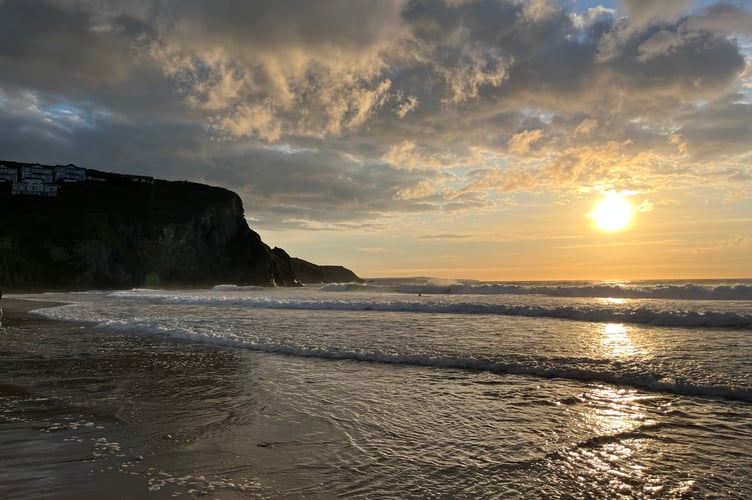
One of the unarguable benefits of living in Cornwall (and heaven knows, there are many) is that the western seaboard makes for a cracking sundown. It’s not exactly news to anyone who lives here, or those who would like to.




But let’s make it official. According to the Global Dusking Index (released by international travel mobile connectivity provider Holafly), Cornwall officially outranks some of the world’s most expensive luxury destinations for the ultimate sunset experience.
The index cross-referenced the actual atmospheric science of what makes a sunset vivid - cloud cover, humidity, air particles - with UK travel demand and social media data across 29 global destinations.
It should come as no surprise to hear that with a massive score of 46.9 out of 100, Cornwall dominated the domestic spotlight tier, scoring nearly 16 points higher than its closest UK rival.
But what might raise a few eyebrows is that it also beat Italy’s Amalfi Coast (44.7), the Maldives (43.1), and the Greek island of Mykonos (40.9).
Why? Holafly points out that while the Maldives might boast millions of TikTok views, the physical science (high humidity and frequent cloud cover) doesn't support the hype. Cornwall's score is driven by a powerful mix of solid atmospheric conditions, massive UK travel demand, and huge digital desirability.
Experts described Kernow as “the undisputed soul of the British evening”, adding: “There’s a raw, end-of-the-world romance to the Cornish coast. Standing on the granite cliffs, tasting the salt in the wind as the Atlantic swell crashes below and the sky burns an aggressive orange, you feel entirely disconnected from the modern world. It is, quite simply, world-class wilderness.”
In second place with a score of 30.8, the Peak District was praised for its “quiet, brooding magic”, while the Jurassic Coast drew plaudits for “the warmth of the golden hour” reflected against its prehistoric limestone cliffs. Northumberland appealed for its “vast, empty landscapes and protected dark skies”, while the Yorkshire Dales enjoys “slow, quiet and deeply soothing” twilights.
I love the fact that someone in a marketing team somewhere has invented a new verb: “dusking”. There’s nothing I like more on a nice day than heading to the north coast for a paddle and a sunset; now I know exactly how to describe that activity.
The family isn’t always on board – last night, we only made it as far as McDonald’s, which I assure you is nowhere near as attractive. But some of our best memories have been made in the half-light of early evening, especially in spring and autumn when the sun goes down earlier.
I don’t live by the coast – journalism doesn’t pay that well – but there are upsides to this, too. If we wake up and fancy a swim, our favourite beaches are a 20-minute drive away on the Roseland peninsula. If we fancy a coastal hike with fabulous westerly views (next stop Canada), we’re equidistant from any number of gorgeous options.
My own personal favourite is Porthtowan, which is jaw-droppingly magnificent at sunset, with panoramic views towards Godrevy and St Ives in one direction, and Trevose Head in the other. At low tide, you can saunter along the beach, admiring a rainbow of colours: yellow sand, blue sky, green seaweed, white foam. At high tide, climb the South West Coat Path and find a handy bench from which to marvel at the prowess of the surfers.
For a little variety, you could head to Trebarwith Strand and have a pint at the Port William with a view over to Gull Rock; or how about Cape Cornwall in the far west, with its vista over the Brisons and, on the finest of days, the Isles of Scilly shimmering 28 miles south west?
The message: the British adventurer doesn’t need to break the bank, endure a 10-hour flight or cross an ocean to find an earth-shattering sunset. The wildest, most moving twilight transitions can be found right on our own shores.
That’s great news in the face of a potential jet fuel shortage – although at this rate, the cost of filling up your car might be as much as a flight to the Maldives.
Comments
We've recently changed our login process. If you have an account for commenting, you will need to re-register on the login window.
This article has no comments yet. Be the first to leave a comment.