
WHAT is a cathedral for? The answer is less straightforward than you think, writes Judith Field.
The first Bishop of Truro, Edward White Benson, knew that not everyone in Victorian Britain thought cathedrals were necessary – or that Cornwall should have a cathedral of its own. To make the case, he published a book – ‘The Cathedral’ – in 1878, and after a vigorous campaign, had the satisfaction of presiding over the consecration of the partly-completed Truro Cathedral on November 3, 1887.
It was a little miracle - the first cathedral to be built on a new site since Salisbury in 1220 – but in his sermon that day, Benson (by now Archbishop of Canterbury) focussed not on the past, but on the future and his hopes for a united church. It would be a challenge!
Bitter arguments about worship had first broken out across Europe in the 1500s, when new ‘Protestant’ churches (including the Church of England) rejected Roman Catholicism. There were radically different beliefs about the role of priests, and the presence of pictures, relics , incense and monuments in churches. Passions ran so high that, even in Cornwall, statues and stained glass were smashed, families split and civil war raged.



Eventually, a new ‘normal’ emerged, with plainer churches and simpler services, until the late Victorian fascination with all things medieval gave us Truro’s splendid Gothic Revival cathedral … and stoked religious tensions that had been simmering beneath the surface.
Many people will have heard of Bernard Walke, the vicar of St Hilary. Arriving in the village in 1913, he transformed the parish church with services, paintings and statues in the style of a medieval Catholic chapel. Scandalised parishioners didn’t know what to make of it, and Protestant campaigners were so upset that, in 1932, they forced their way into the church to destroy the offending items.
But St Hilary was not the only place with ruffled feathers – Truro Cathedral also came under fire, thanks to its monastic Bishop, Walter Frere, and wealthy art-collector Athelstan Riley, who had a house at Little Petherick, near Padstow.
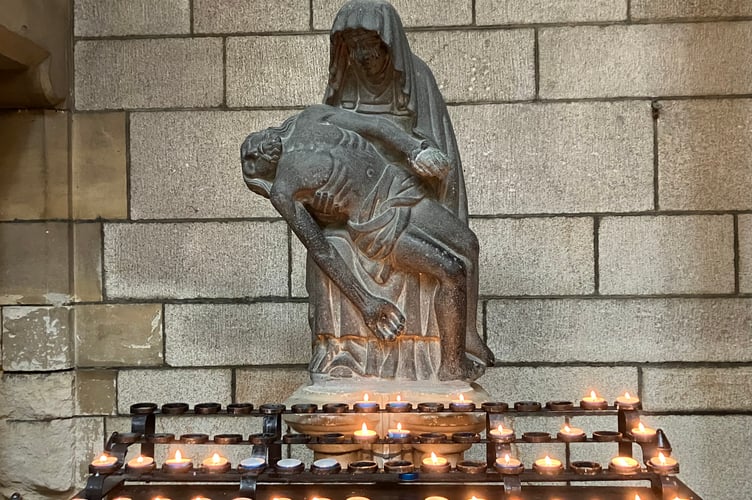
Like the Bishop, Athelstan Riley was a devout Anglo-Catholic, and an expert on historic sacred objects. In the late 1920s, he gave the cathedral an ornate silver box called a pyx (for keeping communion wafers) and two medieval statues from Brittany – one of St Nicholas and one a ‘pietà’, depicting the Virgin Mary weeping over the crucified body of her son.
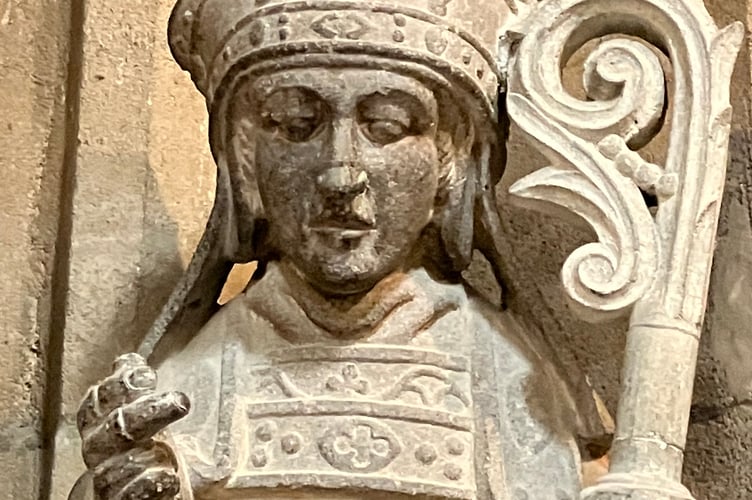
Predictably, not everyone was pleased, and after a petition, the pyx was moved from St Mary’s Aisle to a less visible part of the cathedral. The statues, however, remained. They have become more and more appreciated for their artistry and spiritual significance until nowadays, thousands of visitors light candles in front of them every year.
If you would like to see the statues, murmur a prayer and light a candle, Truro Cathedral opens daily at 10am. There is still no charge for entry, but each donation helps to preserve this precious building for Cornwall.
Comments
We've recently changed our login process. If you have an account for commenting, you will need to re-register on the login window.
This article has no comments yet. Be the first to leave a comment.