
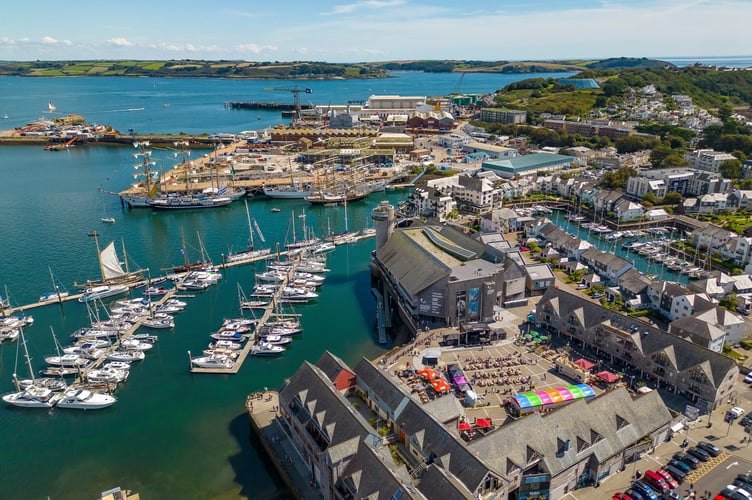
RESIDENTS have raised serious concerns about plans to dredge Falmouth Harbour as part of a £150 million redevelopment project.
More than 400 people packed The Cornish Bank on Church Street for a public meeting to discuss the plans to modernise the 165-year-old shipyard to accommodate much larger modern vessels, which has sparked a fierce environmental and political battle.
A large crowd gathered in the street to hear the passionate debate on speakers outside the building as the building was full to capacity.
Drystan Jones, director of port development at Balaena, the Gibraltar-based company that took over the docks last year, joined a panel of speakers including Dan Barrios O’Neill of Cornwall Wildlife Trust, local fishers Paddy Vinnicombe and Jason Pascoe, artist and climate campaigner Francesca Williams, and Bella Bunce of the rapidly growing Stop the Dredge Campaign.
Dan O’Neill laid out the reasons why the Wildlife Trust sees the current plans as potentially highly damaging to one of the UK’s richest marine ecosystems.
He stressed that the material to be dredged, nearly a million cubic metres of it, contains some of the most toxic sediments of any in the British Isles, with high levels of materials including mercury, lead and Tributyltin (TBT), a compound used in marine antifouling paints that severely damages aquatic life. He emphasised that it was not just the effect of individual contaminants that should be considered, but their combination, and that there needed to be laboratory testing to study how this would affect marine organisms.
Noting that three-quarters of the sample cores taken in the harbour are over safe limits for disposal at sea, Mr O’Neill also said that inadequate sampling means that it will not be clear which loads of spoil are most contaminated, and that this would probably result in highly toxic material being dumped offshore in an area just outside the Fal and Helford Area of Special Conservation.
Mr Jones said that the dredging was essential if Falmouth is to prosper as a working port and offer good jobs to local people, taking advantage of opportunities not just for more port visits by cruise ships but also for potential work on infrastructure for the rapidly growing offshore wind industry.
He said that all due care and attention had been put into the dredging plan, which had been developed in consultation with Natural England and the Marine Management Organisation. Dredging, he said, would be carried out on ebb tides, minimising the risk of sediment spreading into the estuary system.
This was questioned by Jason Pascoe, who said that the plans showed little understanding of the reality of local tides and winds. Mr Pascoe, who has fished in the area for many years, said that plumes of contaminated sediment suspended in the water would inevitably drift for days through waters used by local fishers. He asked why the plans did not include the use of ‘silt curtains’ that might help to reduce this risk.




Oyster fisherman Paddy Vinnicombe echoed these concerns, saying: “If the development goes forward and this toxic cocktail leaches into the fishery, it’s not just oysters that will suffer. This is the last natural oyster fishery in the country, it’s been here for hundreds of years and it’s just starting to take off again. If this happens, we won’t be able to carry the torch forward.”
Mr Pascoe said that, in 2001, dumping of a much smaller quantity of spoil in the same area earmarked for dumping of material from the planned dredge had effectively wiped out fish stocks there for five years. He said that there was a high risk of catch from the area being contaminated and that these fish travel over many miles – so the whole of the Cornish fishing industry could be harmed.
Francesca Williams noted that the cruise ship industry is one of the most polluting industries in the world, in terms of carbon emissions and other forms of pollution, and asked how Falmouth facilitating more and larger cruise ships aligned with the Paris Agreement to curb greenhouse gas emissions. “Decisions you make today may not look good in the light of history,” she said.
Bella Bunce of Stop the Dredge said that a vast increase in the number of cruise ship visits would have far-reaching impacts on the town and risked destroying the very reasons why Falmouth is loved so much by residents and tourists alike. She also questioned whether there had been adequate public consultation over the plans, and said that many local residents had only recently become aware of their implications.
The discussion was then opened to questions from members of the public. There were far more of these than could be addressed in the time available, with issues raised including air pollution from cruise ships running their engines in port, stress on already overloaded local services, congestion on local roads from thousands of lorry-loads of highly contaminated spoil that would need to be transported through town, and questions around the rigorousness and accuracy of assumptions made in the plans.
Jayne Kirkham, MP for Truro and Falmouth, was at the meeting and defended the plans, saying that she was “disappointed” that so many people felt there had been inadequate public consultation. She said that she would work “to make sure that everything is done properly” in ways that minimised harm to the environment.
There were many calls for an extended public consultation period, and Drystan Jones said that he saw this meeting as “the start of the conversation”.
Bella Bunce of Stop the Dredge said: “It was incredible to see so many people show up. Falmouth is an amazing community – we really care about our neighbours and about what happens to the ecosystems and natural environment we all depend on in so many ways.
“Stop the Dredge are not opposed to the modernisation of Falmouth’s docks, but we want to be sure that this is done in ways that don’t lead to irreversible environmental damage.
“It was clear from the evening that the public have a lot of questions, and many remain unanswered.”
Comments
We've recently changed our login process. If you have an account for commenting, you will need to re-register on the login window.
This article has no comments yet. Be the first to leave a comment.