

A PLAN to finally get the massively delayed Pydar development moving in Truro has been submitted to Cornwall Council for approval.
Treveth – the council’s construction company – has lodged an outline application for up to 320 homes, 400 student bed spaces, 16,500sqm of non-residential floor space and associated works, with all matters reserved (meaning full details will be provided further down the line).
It is basically a variation of the new city neighbourhood previously approved in 2021, but now makes it more viable and deliverable in the current economic climate, while also responding to social and policy changes.
These include the lasting effects of the Covid pandemic on Truro city centre, including reduced retail demand, changing footfall, vacant units and new working patterns, which have increased the need to rethink city centre uses.



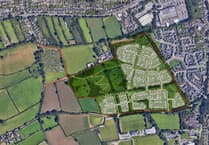
The huge development has been a victim of the downturn in the economy and increased inflation. At one point, the £170m costs escalated to almost £200m. Treveth now plans to create Pydar at between £120m and £150m.
The new application, for what would be known as Pydar Gardens, sees the same number of dwellings, student bed spaces and amount of commercial development as previously approved.
The application says the development “would still remain very much in the spirit of the [original] consent, through providing a major residential led, mixed use regeneration scheme.
“They will help unlock major housing delivery and job creation on a key brownfield, allocated site that has been earmarked for redevelopment for a considerable period of time. The revised illustrative masterplan, which is a realistic and viable option for the site, is also considered to be better reflective of the area in terms of layout, scale and character”.
The site extends to approximately 4.5 hectares and has now been cleared of all buildings. It previously included several car parks, former council and NHS offices, Truro Bowl, retail units on St Clement Street and vacant or partially derelict warehouse buildings.
Existing streets connecting Pydar Gardens to the city centre will be enhanced through improved public realm and a stronger landscape structure. Pydar Street and St Clement Street will form “key urban edges and gateways, with greener, more legible and pedestrian-friendly routes”.
Pydar Green will form the central green heart of the new neighbourhood: “a generous, multifunctional open space for gathering, play and relaxation. It will provide a high-quality landscaped setting that supports everyday community life, balancing open, flexible areas with quieter, planted edges and an attractive outlook for surrounding homes”.
Oak Way will form a landscape-led riverside corridor shaped by the River Allen. It will create an accessible, biodiverse green route that supports walking, cycling, informal recreation and everyday enjoyment of the river setting.
Areas to be developed are defined by a central open space, with access points from Pydar Street and there is to be a one-way route connecting Oak Way to St Clement Street.
A diagonal route that connected the corner of Pydar Street and St Clement Street to the River Allen, which was to be an extension to the existing retail high street, has been removed, with a shift from a fixed street hierarchy to simplified principles for access and movement through the site.
There will be no new proposed pedestrian bridges across the River Allen, with existing crossings to be retained. Access off Pydar Street will be moved south of the junction from Castle Rise. The former primary and secondary open spaces that were to the west and east of the masterplan have been consolidated into a central location.
Previously, one parcel off Pydar Street was allocated for educational uses. Educational uses are now included in an area of mixed uses on the southern section of the site adjacent to St Clement Street. This is to increase flexibility of where uses are placed within the masterplan.
A new approach simplifies the connecting heights between taller four to six storey blocks that were formerly joined by one to three storey courtyards as part of the 2021 consent. This is to allow the development of the most suitable orientation and massing at detailed design stages. Heights range from four to six storeys across the majority of the site.
New pedestrian routes will connect the open spaces Daubuz Moor, Victoria Gardens and the River Allen corridor.
The details of parking provision will be determined at a later reserved matters stage. However, parking plans will seek to reduce the extent of vehicle movement across the site.
Parking provision will also “reflect the availability of public parking within nearby city centre car parks”, despite the city’s parking provision reducing quite dramatically in recent years, partly due to the demolition of existing car parks to make way for this very development.
Find out about planning applications that affect you by visiting the Public Notice Portal.
For more details see outline application PA26/03332.
Comments
We've recently changed our login process. If you have an account for commenting, you will need to re-register on the login window.
This article has no comments yet. Be the first to leave a comment.