
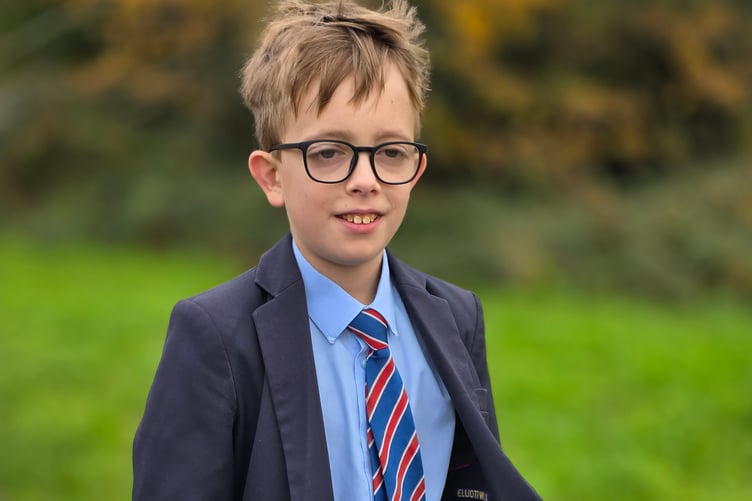
A TRURO boy saved by a major emergency transfusion after losing seven litres of blood is urging more people to donate blood.
The NHS has revealed fewer people are donating critical blood types, including the vital O negative that saved the life of 13-year-old Elliott Wills.
Elliott lives with a blood disorder called spherocytosis, and was recovering from routine surgery last October when he suffered a burst main artery and haemorrhaged so much, doctors told his dad Phill to prepare for the worst.
As Elliott was rushed to theatre, Phill watched porters running down the corridor with bags of blood; but Elliott was bleeding as fast as the blood could be transfused, and a team of 20 people battled for three hours to save him.
.jpg?width=209&height=140&crop=209:145,smart&quality=75)

.jpg?width=209&height=140&crop=209:145,smart&quality=75)

The Penair School student survived thanks to the skills of the medical team and 23 units of blood products, potentially from 23 individual donors - the equivalent of seven litres, or three times his body’s circulatory volume.
He’s now doing well and looking forward to his 14th birthday on June 29 - an occasion his family say he would not have lived to see without blood donors. That’s why they are speaking out during National Blood Week (June 8 to 14), urging more people to give blood regularly.
“While Elliott was packing his hospital bag, someone out there was donating the blood that would save his life,” said Phill, 53. “Donors are heroes and so are the NHS teams who get the blood from the donor’s arm into the veins of a desperately ill patient like Elliott.”
Elliott has the rare B negative blood type but his life was saved by emergency supplies of O negative blood. O negative can be given to anyone and is used in trauma scenarios when a person’s blood type is not known or if a hospital does not have fast enough access to stocks of a patient’s blood type.
However, NHS Blood and Transplant reveals the number of regular donors with the in-demand types O negative and B negative has dropped five per cent since 2020. Around 107,000 people with O negative blood donate regularly, while there are around 20,000 regular B negative donors.
Spherocytosis causes severe anaemia and Elliott has received routine transfusions of B negative blood to help him stay well. But last year complications from a virus left him needing his spleen and gall bladder removed.
During the five-hour procedure at Bristol Royal Hospital for Children, Elliott received three units of B negative blood that were on stand-by to replace the blood he lost. The surgery appeared to go well, but later that evening Elliott’s blood pressure suddenly plummeted and an emergency ultrasound revealed massive internal bleeding.
“All of a sudden people appeared from nowhere,” said Phill. “A chain of porters came running past me carrying bags of blood. As they whisked Elliott away, I had just enough time to tell him I loved him.
“That day was my eldest son’s 25th birthday and all I could think was, please don’t take Elliott on Josh’s birthday.”
Phill is a carer for wife Gill, who lives with a spinal condition and is currently recovering from major surgery. She remained at the family home in Truro with Elliott’s 12-year-old sister Marnie while Phill waited for news.
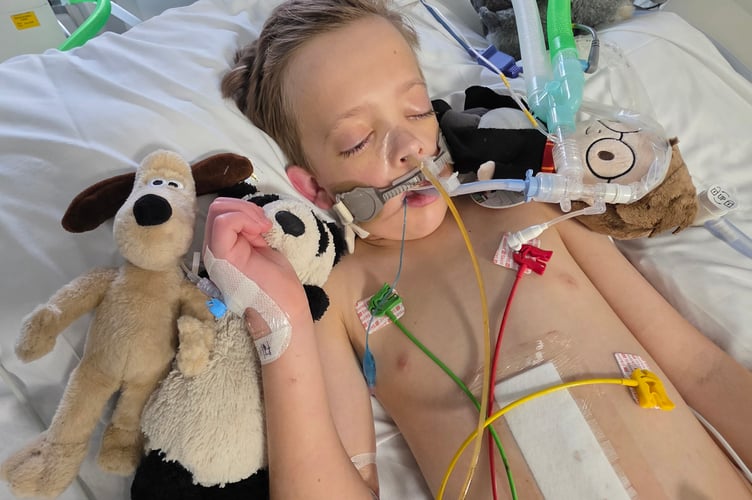
Eliott spent three days in an induced coma. He then endured another setback when he suffered two seizures triggered by the trauma to his brain. But he recovered and after spending three weeks in hospital he was well enough to continue his recovery at home.
“When Elliott’s notes said he’d lost seven litres I thought it was a typo,” said Phill. “Surely no-one can survive losing that much blood. But Elliott is living proof they can, as long as the vital supplies of donated blood are there.”
Elliott returned to school in April and is making good progress. He tires easily and needs to take extra care when playing sports, but the devoted Manchester United fan is enjoying playing football with his friends once more. “Elliott is kicking a ball about again because blood donors gave him a second chance at life,” said Phill.
Elliott said: “Thank you to everyone who gives blood. It helped saved my life. If you are thinking of giving blood, please do. I’m looking forward to a birthday I didn’t think I would have. Thank you, blood donors, for my gift of life.”
The NHS needs over 155,000 new donors to give blood this year to ensure it has the right mix of donors to meet the needs of patients. This includes 18,500 donors with priority blood groups O negative and B negative, plus 16,000 extra donors of Black heritage to come forward to help improve treatment for patients with sickle cell.
Just eight per cent of the population have O negative blood but it makes up around 16 percent of hospital orders, meaning it is in constant high demand. Only two per cent of the population have B negative blood, although it can be safely received by up to 13 per cent of patients. Both groups are highly vulnerable to shortfalls.
Gerry Gogarty, director of blood supply for NHS Blood and Transplant, said: “It’s wonderful to hear about Elliott’s recovery and of the gratitude he and his family have for blood donors.
“Bblood donations not only ensured Elliott survived a life-threatening bleed but also helped him to manage the blood disorder he lives with. His experiences shine a light on some of the many ways donors save and improve lives every day.
“The NHS needs more people to give blood to help people like Elliott. All donations are vital but new donors with O negative, B negative and Ro blood are especially needed.
“You don’t need to know your blood type as you will find out after your first donation. Simply register and book an appointment. You may discover you have one of the ‘missing types’ patients need right now.”
Register via the NHS Give Blood app or at www.blood.co.uk.
Comments
We've recently changed our login process. If you have an account for commenting, you will need to re-register on the login window.
This article has no comments yet. Be the first to leave a comment.