
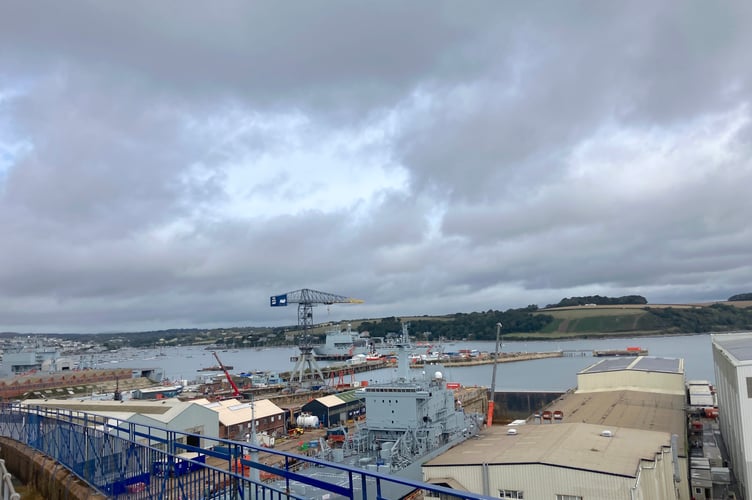
An application to “modernise” and “future-proof” Falmouth Docks has been approved by Cornwall Council’s strategic planning committee, despite public concerns for the town and its marine environment.
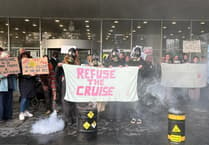
Around 150 people gathered at the entrance of County Hall yesterday morning [Friday, November 19] with banners and gas masks to protest against development and dredging in Falmouth Harbour. They sang and handed out information to those entering the building, before sitting in the public gallery to hear a meeting of the strategic planning committee to discuss an application to carry out work at the dock.
More than 700 submissions opposing the plans have been made via Cornwall Council’s planning portal, and over 5,000 people have signed a petition protesting primarily against a major dredge, claiming it could do severe damage to the Carrick Roads marine ecosystem including protected habitats and local fisheries.
The meeting itself concerned not the dredging, which is subject to a licence from the Marine Management Organisation (MMO), but an application by Balaena, the new owners of Falmouth Docks, for works to redevelop and modernise the existing infrastructure. These include the demolition of eight buildings, partial demolition of existing wharf structures and the construction of new ones, and a new area to build floating offshore windfarms (FLOW).
Wind turbines would be assembled in the docks by 150m high cranes before being towed out to sea with a maximum of two present at any one time. Councillors were shown computer-generated images of how these would affect the view from as far away as St Mawes across the Carrick Roads; however, they were assured their presence would be temporary.
Planning officer Mark Ball declared: “The adverse impact is considered to be outweighed by significant public benefits. Taking all factors into account, the proposals are considered acceptable subject to conditions.”
While councillors were broadly in support of the economic benefits the work would bring to the docks, and the town by association, there were nevertheless concerns about its potential environmental impact on Falmouth, and debated this at length.
When finished, the dock will be able to accommodate 11 more cruise ships each year, and these will be able to pull up alongside rather than anchoring at sea and bringing passengers in by tender. Concerns ranged from increased air pollution from cruise ships brought closer to shore and running their engines, to a doubling in visitor numbers to 200,000 per annum – the equivalent of the crowds of Falmouth Week.
A key concern was the amount of construction traffic required during peak hours. Planning officer Mark Ball estimated this could be a worst-case scenario of 488 vehicle movements daily, around three-quarters of which would be HGVs. A commitment had been made to reduce this by 25 per cent, for example by removing waste by boat rather than by road transportation. Under questioning, it was confirmed there were no plans to dump toxic dredging waste at sea.
Speakers included environmental data scientist and Falmouth resident Timothy Hughes, who had supplied a 26-page technical report highlighting health and environmental concerns.

To applause from the public gallery, he said the planning recommendation had ignored many of the harms and overestimated the economic and employment benefits while failing to acknowledge their uncertainty.
Falmouth Docks director Drystan Jones said that the plans had been designed to minimise adverse environmental impacts following extensive consultation. He said: “This project will ensure that Cornwall has a modern, fit-for-purpose deep-water berth facility to bring international visitors ashore in a scheduled way to support the local visitor economy without increasing pressures on the local housing market.
“Balaena is committed to supporting UK Ministry of Defence and this project will ensure that Falmouth continues to support Royal Navy and Royal Fleet Auxiliary vessels. If we are serious about providing skilled local jobs and apprenticeships, rebuilding Britain’s industrial strength and strengthening our national security, then we must make full use of shipyards and must therefore ensure that port infrastructure is ready to deliver.”
Mr Jones added that half Falmouth’s cruise ships currently tender passengers into town on smaller boats which are weather-dependent. “It only takes a bad season, and suddenly those visitors just can’t come ashore,” added Mr Jones.
Members whose wards cover the area, including Cllrs Laurie Magowan, Debra Clegg and David Saunby, were broadly in support of the application. Cllr Magowan brought it to committee because of the impact it could have on local highways, especially Melville Road; however, he said he was pleased to hear there would be a minimum 25% reduction in vehicle movements.
Penryn councillor Dean Evans also supported the redevelopment, but believed the “extensive dredge” was unnecessary and wanted the current plan refused so Balaena could submit “a better application that just deals with the reconstruction of the docks so that Falmouth can carry on doing what it does well”.
Wider councillors were also largely positive about the application. Cllr Martyn Alvey (Conservative, Feock & Kea) said: “The docks were my playground during the 1960s. My father worked there. So this is quite an emotional application for me. I have a strong commitment to the environment, and this comes down to a balance between some very clear negatives and a raft of significant positives. On that basis, I’m coming down on the side as seeing this application as important and worthy of approval.”
Cllr Peter Channon (Reform, Hayle West) said: “I love Falmouth, and the docks area is important for the economy and for local jobs – it’s important for Cornwall, and for the UK. We could have a fantastic facility here, that would not dominate the area to the point of spoiling it. I think the application is reasonable, and there are plenty of conditions in place to protect the area.”
He said the dredging element would be dealt with by the MMO and Environment Agency, but added: “A great number of people have turned out to support this meeting and I think we should show that we have listened to some of their concerns.
His proposal was seconded by Cllr James Ball (Independent Roskear and Tuckingmill, Camborne), who said: “The economic benefits for Cornwall are huge and the environmental benefits with the FLOW are going to be huge.”
Cllr Adrian Parsons (Liberal Democrat, Altarnun & Stoke), who said: “Great Britain had a reputation of being a great sea-faring nation, whether for movement of people or trade. Strategically, Falmouth is integral to how we function in all of that. The question is, do we want to live on the great things of the past, or look forward to the future?
“I think when I see what we have in front of us at Falmouth Docks, parts of this application involve the regeneration of the facilities, which is an unavoidable requirement. Controls tend to be rigorous to the point of onerous to make developments happen; I think we should be confident in that.”
However, Cllr Andrew Long (Mebyon Kernow, Callington), said: “Cruise ships are not environmentally friendly vessels. They are polluting vessels. I see no economic reason to potentially damage the environment to enable people to step off a boat onto dry land, rather than onto another boat and onto dry land. I do not see how that’s going to benefit the economy, so I can’t support the application as it stands.”
His concerns were echoed by Cllr Jim Gale (Reform, Lynher), who said: “There is a lot of strong feeling in the public gallery, and once we make this decision today, that’s it in tablets of stone. The docking of the cruise ships does concern me. I have serious reservations.”
While the dredging was not under discussion, it was often mentioned, and committee chairman Chris Batters regularly had to call for calm in the public gallery, to the point of threatening to pause the meeting and continue without an audience.
Find out about planning applications that affect you by visiting the Public Notice Portal.
The application was passed by seven votes for the proposal and three against, with no abstentions, to the disappointment of those in the public gallery.
Comments
We've recently changed our login process. If you have an account for commenting, you will need to re-register on the login window.
This article has no comments yet. Be the first to leave a comment.