
WHAT would it be like to live in a country where someone was above the law? That was the nightmarish scenario people faced in the 13th century, writes Judith Field.
King John, younger brother of Richard the Lionheart (and sworn enemy of Robin Hood), inherited the throne in 1199. Devious and cruel, and widely suspected of murdering his teenaged nephew Arthur with his bare hands, John was described by Medieval chronicler Matthew Paris as “a king who went straight to Hell”.
Considering himself above the law, John used ruthless tactics to steal from rich and poor alike. By 1215, the whole country had had enough.
A rebellion of northern Barons quickly spread and was backed even by some of John’s own tax-collectors. Among the rebels was William de Wrotham, the first Lord Warden of the Cornish Stannaries – the man trusted by John to squeeze every penny out of Cornwall’s tin mines.




A stand-off developed between the Barons and the King. One week in June, the warring parties warily met at Runnymede, on the banks of the Thames near Windsor. There, King John was forced to accept a deal: Magna Carta, hailed “the most important constitutional document ever written”.
Magna Carta established the right to protection from arbitrary arrest and punishment, and the right to trial by jury. But the most revolutionary clause created a council of 25 Barons with the power to force the King to abide by the rule of law. It was the seed that later flowered into democracy, and Magna Carta underpins the constitutions of dozens of modern-day countries including the USA, India and Australia.
Villains achieve notoriety, so everyone remembers Bad King John. But how many people know who wrote probably the most significant peace-deal of all time?
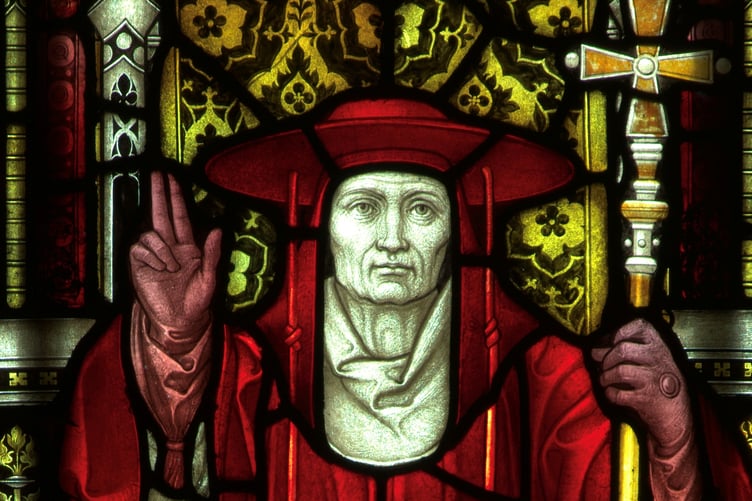
A window in Truro Cathedral pays tribute to Stephen Langton’s spectacular rise from Lincolnshire villager to Archbishop of Canterbury, and one of the foremost scholars of the Medieval Age. He then took on the riskiest task of his life – negotiating Magna Carta between King John and the Barons. If he had failed, civil war would have broken out.
Naturally, King John reneged on his side of the agreement within a month, causing the revolt to flare up. Langton was suspended from his post as Archbishop of Canterbury for refusing to back the King, and all seemed lost.
It took John’s unexpected death from dysentery in 1217 to re-unite the kingdom. To cement the peace, the rebels and John’s nine year-old heir, Henry III, agreed to re-issue Magna Carta, which has now become a powerful symbol of liberty throughout the world.
And what of its author, Stephen Langton? His other claim to fame is that he divided up the Bible into the chapters we use today, enabling us easily to find Matthew 5.9: “Blessed are the peacemakers…”
Truro Cathedral is a charity, open daily, with a scheme of story-telling windows featuring 108 real-life characters. Find out more at www.cornishstainedglass.org.uk.
Comments
This article has no comments yet. Be the first to leave a comment.