
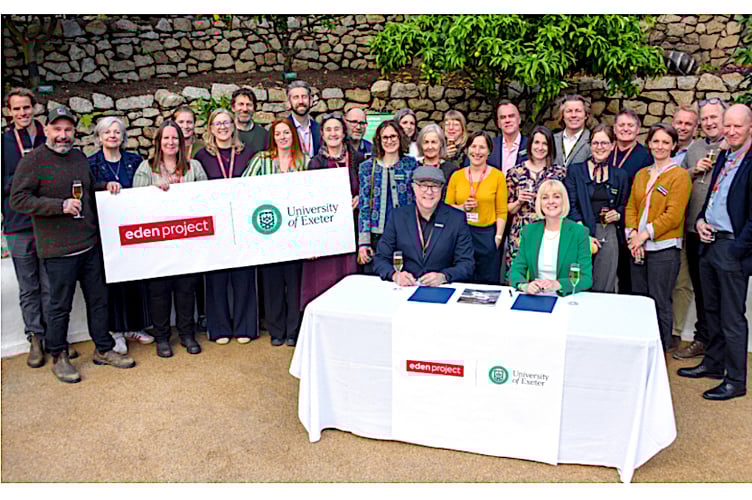
THE challenges of climate change and biodiversity loss are at the centre of a new strategic agreement between the Eden Project and the University of Exeter.
The agreement, which continues a longstanding partnership, was signed at a ceremony in the Mediterranean biome of the Eden Project near St Austell.
Research, education, public engagement, innovation and policy-influencing initiatives are covered by the agreement which aims to expand the scope of the partners’ work together, moving from knowledge creation to leading and inspiring measurable change.
Eden Project chief executive Andy Jasper said: “Strengthening this partnership with the University of Exeter comes at a significant time as the Eden Project celebrates 25 years. As an educational charity, we provoke curiosity and champion creativity.




“Fostering regenerative mindsets is a shared value and, with this renewed commitment, we look forward to turning knowledge into meaningful actions and accelerating solutions that help communities, ecosystems and our gardens thrive.”

Professor Lisa Roberts, president and vice-chancellor of the University of Exeter, said: “Our partnership with the Eden Project is truly distinctive. Through collaboration on storytelling, nature-based solutions and the circular economy, we have created engaging public events and activities that have taken our research out into the world.
“This renewed agreement signifies our commitment to working ever more closely, building upon our world-class strengths to tackle the challenges of global climate change and biodiversity loss.”
The partners say the agreement is based on a joint vision – one of reconnecting people with the rest of the natural world, driving nature recovery and working with nature to enhance growth, health and security.
They want the agreement to build on more than a decade of innovative work, including the Greengage project to understand the impact of socially-prescribed activities in nature, the Eden geothermal project and students engaging with the Eden Project as a study site.
Comments
We've recently changed our login process. If you have an account for commenting, you will need to re-register on the login window.
This article has no comments yet. Be the first to leave a comment.