
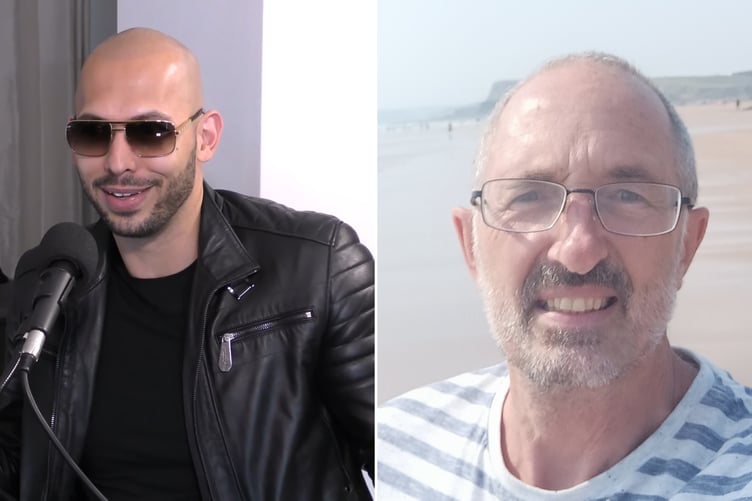
A COUNSELLOR based in Cornwall has expressed his concerns about the risks facing young men with the rise of the manosphere.
John Walter has been a counsellor in Bude since he returned to his hometown some ten years ago. However, after being stunned following a viewing of Louis Theroux’s most recent documentary, Inside the Manosphere, John took to social media to prompt discussion surrounding the feelings of young men.
In the film, documentary-maker Mr Theroux gets behind the scenes access to the lives of a number of online ‘manosphere’ content creators who are advocating for hyper-masculinity, controversial gender roles and pushing a ‘red-pill’ philosophy – telling viewers, often young men, to ‘wake up’ to the supposed reality of the world, something heavily linked to radicalisation into far-right politics.
After watching the documentary, having worked with boys and young men in the education and care sector since 1985, John said it troubled him deeply.




“I watched the Louis Theroux documentary, and it really disturbed me, I couldn’t sleep. It was so horrible,” he told us.
“I work a lot with boys, and I was thinking a lot about all the pressures that boys and men are facing. When I was around as a boy in the 60s we didn’t have access to the social media stuff, so your role models were your dad, your uncle, the guy next door and that sort of thing. And you basically got drawn towards different types of masculinity and you could make your own choices.
“However, it has gotten so polarised now, especially with social media being targeted towards making money. They [manosphere creators] don’t care about boys, they just want to make money for themselves.”
Despite his horror at the behaviours of content creators he saw on screen, John said that some attitudes being displayed aren’t as uncommon as people might think.
“I am very aware [of these attitudes],” he said. “I work with couples and quite often in a relationship there can be a dynamic where someone says, ‘I’m the one who earns the money’ and there is a controlling patriarchal side to that.
“‘The man earns the money, and the woman does the dishes’ - that horrible stereotype. And growing up in the 60s I thought that had disappeared, because in the 60s people were beginning to say that we don’t do that anymore, but it seems to be coming back in glorious technicolour, with the manosphere.”
John has called for families, the community and those with a connection to young men to do their bit to help them feel seen and heard, in an effort to combat this epidemic. He said: “I don't think the answer is telling boys that masculinity is a problem. And I don't think the answer is going back to some warrior or business success template either.”
He suggested that manosphere creators are simply filling the space which has been left by society.
“All therapy is really about is that you develop your personality and the way to survive in relation to your parents. However, as you grow up, you then have to try and translate that into the wider world and you find out that people don't relate in the same way that your parents did. So, you have to find your own way of relating out there.
“The sad thing with this manosphere is that it’s jumping into that vacuum. There are young people that don’t have very good role models around them and so the manosphere can jump into that space because there is no one else to fill that vacuum.
“Young people are looking for role models and, in some places, they are getting them. In Bude, we have surf clubs, RNLI, sports groups – so they are getting them that way, but those that aren’t are having these creators fill that space.”
He said that in filling this space, creators – whose main motivation is increasing viewership and in turn, their income - are telling boys that in order to be a man, they must be masculine, unfeeling, in many cases heterosexual, and dominating.
However, when asked what he feels it means to be a man, John said: “It means being present, being able to hold space, being able to relate to family and friends without defensiveness or posturing, able to hold feelings from all ends of the emotional spectrum, to create and nurture a space where everyone can feel their own sense of safety.”
And amid the rise of these manosphere creators, John is still hopeful that there are positive role models for boys.
“There are role models out there for young men, the Artemis crew is a good example. There was a news story, with a picture of two men hugging and crying after naming a crater in honour of one of their deceased wives. They were embracing and crying in front of the world, and I think that’s a pretty good role model. It's about community and connection, feeling vulnerable, and being sensitive to each other.”
Above all, despite his concern and shock, John believes that as a society and community, we are still able to support young men and help guide them when they feel lost.
“I think the key is talking about it. Having the opportunity to talk to someone about it in a real way, rather than a way which is driven by money and fame,” he said. “It is about creating a safe space where young people aren’t being taken advantage of.
“As a counsellor, it can be me who ends up stepping in to support young boys who are having a difficult time at school. Maybe they’ve been expelled, because they’ve gotten into some behaviours which aren't working within the school system, and the way I see it working is just by being able to talk and express themselves and feel a connection with somebody, it can calm their whole system down and they don't need to go searching for quick highs or validation.”
Comments
We've recently changed our login process. If you have an account for commenting, you will need to re-register on the login window.
This article has no comments yet. Be the first to leave a comment.