
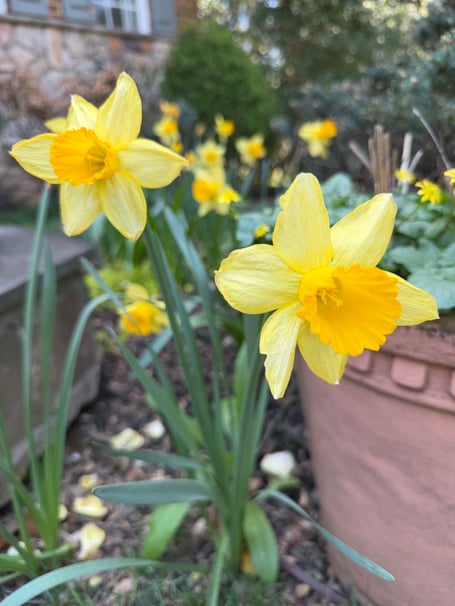
AS I stood in the garden this week, gently deadheading the daffodils, I found myself pausing longer than expected.
The blooms that had carried such brightness only days ago were now fading, their petals softening, their time quietly passing.
It was last autumn that I had planted the bulbs, writing the names of friends, family, and places directly onto them. There was something quietly meaningful in that act, a small private mapping of memory onto the earth. As spring arrived, I knew exactly where each one had been planted, and when they emerged I found myself thinking of the person or place each bloom represented.
When the first daffodils appeared, they were never just flowers. They were reminders, a name held in soil, a connection reappearing in light and yellow and movement. Some made me smile, others made me pause, but all of them made the garden feel less like a space and more like a story unfolding over months.


-Callum-Turner-(Liam)_Courtesy-Bosena_-Photo-by-Ian-Kingsnorth.jpeg?width=209&height=140&crop=209:145,smart&quality=75)

Now, as I move through the garden removing spent flowers, I find myself reflecting from the other side of the season. What was once anticipated and named is now gently passing, and yet it does not feel like loss. It feels like completion.
There is a kind of honesty in that cycle that is difficult to find elsewhere. In planting with intention, watching things emerge without control, and then accepting their fading without resistance, the garden offers no permanence, only rhythm. Nothing stays in its moment forever, and everything moves through it in its own time.
We often think meaning depends on duration, on how long something lasts or how steadily it remains in view. That can be true. Yet a garden can also teach other lessons about beauty. Some of the most vivid things in life are also the most temporary, and their value is not reduced by their brevity.
As I continue through the rows, I think again of the names I placed on those bulbs. Some belong to people close at hand, others to places that live further away but are no less present in memory. Each has had its moment in the season, and now they return inward again, back into earth and back into quiet.
What remains is not the flower itself but the attention it created, the brief interruption of ordinary time, the way it made me notice differently, and how it connected memory to something living for a short season. The collective bloom also reminded me of the quiet power of friendship and community, how separate names and lives can, for a time, share the same light.
I know the daffodils will return next spring and I will be there again in autumn, planting more bulbs and writing more names upon them, names of people and places in Cornwall, Scotland, and beyond. As I feel the soil, I will feel those connections again, and understand once more how even the simplest acts in a garden can hold something enduring and special.
Comments
We've recently changed our login process. If you have an account for commenting, you will need to re-register on the login window.
This article has no comments yet. Be the first to leave a comment.