
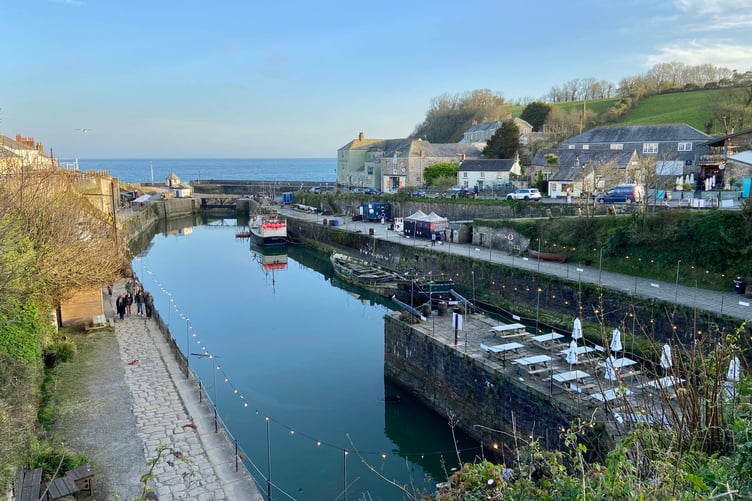
Lyndon Allen has been researching the history of the Georgian port of Charlestown, near St Austell, for many years.
The local historian now says he has discovered facts that challenge some aspects of the accepted story of the port which is part of the UNESCO world heritage Cornwall mining landscape.
Lyndon, who gives talks about Charlestown, says evidence he has gathered points to the fact that the change of name of the settlement from West Polmear to Charlestown took place around four or five years earlier than previously thought in 1796. This was when development of the industrial harbour transformed the small coastal community.
The harbour was built in the 1790s by Charles Rashleigh to export china clay and copper ore produced in the St Austell area and took his name.
Lyndon painstaking searched through the journal of Charles Hatchett, who had met Charles Rashleigh in Cornwall, for evidence.
The local historian said: “After many hours of searching, I found the following entry in his journal, A Tour Through the Counties of England and Scotland in 1796, Visiting Their Manufactories. Hatchett visited the village on May 9, 1796, and wrote: ‘Went with Mr Charles and Mr Jonathan Rashleigh to see Charles Town built by the former. The town, the pier of granite and a considerable wet dock which at high water has a depth of 15 feet, with rope walk, store houses and fish cellars including the improved lands about, has been done upon the sole plan and at the sole expense of Mr C Rashleigh upon his own estate – a wonderful work for a private gentleman.’
“Hatchett added: ‘The whole has been begun about three years.’ This is the most compelling evidence yet. Hatchett not only used the name ‘Charles Town’ in May 1796, but described the harbour, wet dock, ropewalk, storehouses and fish cellars. His words show that the name was already in use while the harbour works were approaching completion.”
Lyndon says that newspaper reports from the period also prove that the name of Charlestown was established by 1798.
In addition, he believes other aspects of the port’s history stand likely to be revised.




Lyndon said: “When I published Charlestown – Time and Tide five years ago, I believed I had uncovered much of the true history of my ancestors’ village. The book was the culmination of years of research into Charlestown’s past, drawing together original records, maps, newspapers and family documents to tell the story as accurately as the evidence allowed.
“But history has a habit of refusing to stand still. Since the book was published, new evidence has emerged, overlooked documents have come to light and fresh research has challenged several long-accepted beliefs about the village.
“That should not surprise us. History is never fixed. Every generation has access to new sources, new technology and new opportunities to examine the past. What one historian accepts as fact may later prove to be incomplete – or occasionally, simply wrong.”
Comments
This article has no comments yet. Be the first to leave a comment.