
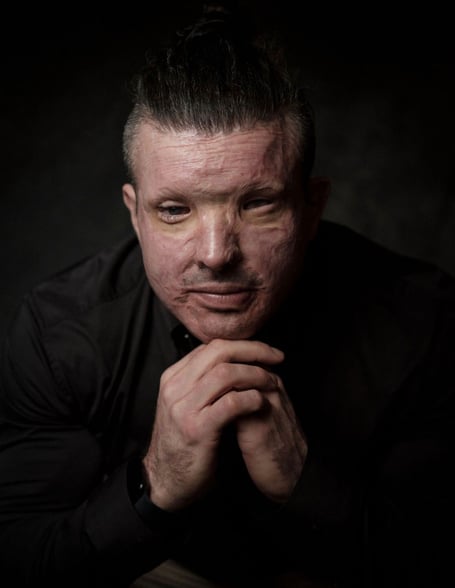
A TRURO man blinded in one eye during an unprovoked acid attack fears the crime has been ‘normalised’ by society, as a new investigation reveals thousands of similar attacks have taken place over the last three years.
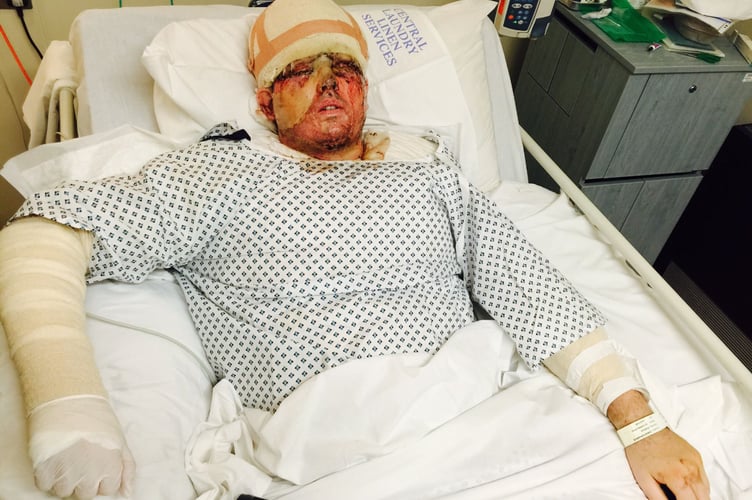
In December 2014, Andreas Christopheros was working from home in the city when he answered a knock at the door. David Phillips had driven 300 miles from Hastings in East Sussex, wrongly believing Andreas had sexually assaulted one of his family members. “This is for you, mate,” Andreas recalled hearing this stranger say to him before throwing a pint of sulphuric acid in his victim’s face and fleeing the scene.
Eight years on, the 40-year-old property manager still lives in the same house on a “very safe” street where he, then-wife Pia and 18-month-old son Theo were on that fateful day. Today, the devoted father is the UK ambassador for Face Forward International - a charity providing support and reconstructive surgery to survivors of domestic violence, human trafficking, and severe cruelty. In September, he plans to cycle from Cornwall to Paris to raise money and awareness for the organisation.
Andreas fears acid attacks have become a staple of life in the UK, after an investigation by personal injury solicitors Legal Expert revealed UK police forces recorded more than 2,600 offences between 2023 and 2025. Disturbingly, 800 of those cases were closed by detectives without a suspect ever being identified.


Devon and Cornwall Police recorded 91 acid-related offences over the same three-year period, equating to 2.5 assaults every month. A third of all cases (30) resulted in the offender making off without identification, while over 90 per cent of attackers went unpunished. A deeply unsettling reality for victims seeking justice is that only five cases resulted in a formal charge or summons, with dozens collapsing due to evidential difficulties or victims declining to support the investigation.
“It’s terrifying to have people out there who deem they can use acid as a weapon and get away with it,” said Andreas. The most troubling aspect of the crisis, he feels, is how frequently such attacks occur: “Acid crime doesn't make the news anymore because it's been normalised in our society,” he added. “It’s like an everyday thing, and people should be extremely worried about that."
In a bizarre twist of fate, Andreas used to live on Lipson Road, Plymouth where a fatal acid attack took place on Danny Cahalane in February 2025. Danny was ambushed in a planned organised crime hit orchestrated by an overseas crime boss over a £120,000 drug debt; he was left with catastrophic burns and died 10 weeks later.
While Andreas bears the physical scars of the attack, he is quick to point out that the trauma in such cases extends far beyond the victim. "It has a massive ripple effect," he explained. "Imagine how you would be if it was your son. My mother, my dad, my sisters, my friends - they all felt an insane amount of pain. I often say I had the easy job - I was the one lying there unconscious. They were the ones who had to deal with it."
Before the attack, Andreas was a highly motivated businessman, directing nine companies and working up to 80 hours a week to build an empire for his family. Today, he directs just two firms, allowing him to work more flexibly and spend precious time with his two sons, 12-year-old Theo and eight-year-old Lazarus.
"I live with the effects of the attack day in, day out," he said. "There is no hiding from the fact that I have full facial scarring and limited eyesight. You get up every morning, you go to bed every night, you see it in the mirror. You can either let it break you or you can own it." Andreas has chosen to own it, dedicating his life to campaigning for a better future for acid attack survivors.
He is fiercely criticical of a justice system he views as fundamentally flawed. His own attacker was originally sentenced to life after pleading guilty to intentionally causing serious physical injury to Andreas. However, following a 2016 appeal, three High Court judges ruled Phillips was not a danger to society, reducing his sentence to 16 years, available for parole after eight. He was moved to an open prison after just five-and-a-half years.
“The punishment here does not fit the crime,” Andreas stressed. “Anybody using acid as a weapon should be facing life with a minimum term of 20 years. But David Phillips is out - not quite a free man, but kind of. He's still on parole, he's not allowed in Cornwall - those are his punishments at the moment, while I’m still financially crippled by what happened to me, and regularly having surgery.”]
Andreas concludes that what dictates sentences is the cost of keeping a prisoner behind bars. He cited the recent case involving Mark Gould, leader of illegal streaming service Flawless, who was sentenced to 11 years behind bars, rising to 21 if he fails to forfeit £2.35-million in proceeds related to his criminal activities.
"How is a man who sells dodgy TVs getting three times the amount of prison time than a man who throws acid in someone's face?" Andreas asked. "His victims are big corporations. No one is physically hurt."
This view is supported by Legal Expert, a prominent UK-based legal information portal and firm of personal injury solicitors, primarily operating on a no-win-no-fee basis. Criminal Injuries Compensation Authority (CICA) specialist Ellie Lamey said: “These figures highlight a deeply concerning lack of accountability for what is a barbaric and life-altering crime,” said, a at Legal Expert. “When perpetrators of such horrific attacks go unidentified, victims are robbed of the justice and closure they so rightfully deserve.”
Andreas has also campaigned tirelessly against the government's 2017 ‘two-strike’ policy, which mandates a six-month sentence for individuals caught carrying acid in an unmarked bottle twice. "Why does anybody need to be carrying acid in an unmarked bottle when they're going out for a walk to the park, or down to meet their mates?” he questioned. “It doesn't make any sense."
He has a poignant message for victims trying to heal without the closure of a court conviction. For a long time during the police investigation, he had to accept the possibility that he might never know why he was targeted.
"It's a very difficult pill to swallow," he admitted. "You've got to rise up, be strong, find bits of normality each day – even watching crappy TV for five minutes - and use them as building blocks to build back a new life.
"It will never be the same. You cannot try and rebuild your life to what it once was. Once you get over that hurdle and you rebuild a new life, then you start surviving.”
In spite of everything, Andreas champions that Cornwall isn’t a dangerous place to live: “To hear there are so many attacks still happening in my area is highly concerning. But I still argue that I live on a very safe street. People say, ‘What? After what happened to you?’. But as far as I'm concerned, Cornwall is one of the safest places in the country.”
Support Andreas’ charity cycle ride at www.justgiving.com/page/andreascycles
Comments
We've recently changed our login process. If you have an account for commenting, you will need to re-register on the login window.
This article has no comments yet. Be the first to leave a comment.