
WE HAVE a lovely, glossy, colourful World Cup wall chart. It came with the Radio Times, whose clever graphic designer has managed to cram in an insane number matches (104!).
We did the sweepstake at the weekend, sharing out 48 teams among family and friends, and daughter can’t wait to fill in the boxes as we get closer to the final square-up. Both things are infinitely more exciting than the actual football itself.
The chart is taped to her wall, next to a list of all her GCSE exams. There are 25 – count ‘em – in total, and each one is scored off with satisfaction as it passes.
We could do with a bingo card to enable us to tick off all the old exam cliches. Forgot pencil case, requiring a parental dash to school before 9am start? Check (twice).




Failure to find school trousers on the morning of a double exam day? Check. In an episode I will henceforth call ‘Trousergate’, we screamed at each other like a pair of fishwives until said garment was discovered crumpled up and buried in a bag of sportswear.
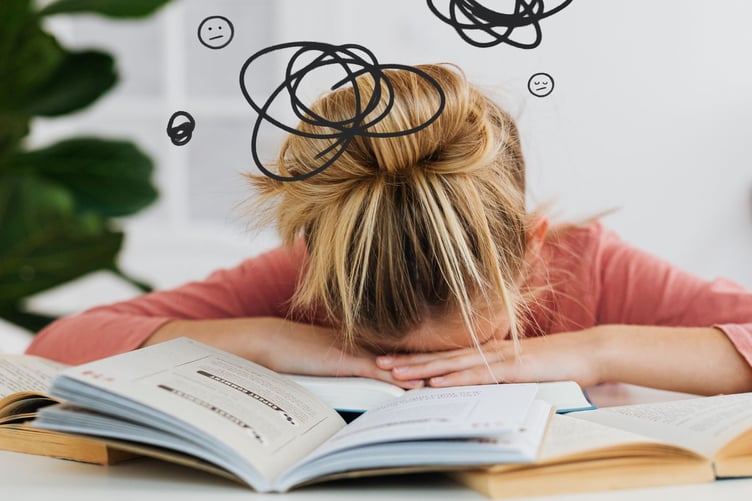
Complete brain melt upon seeing a dreaded question early on in a paper? Check. “It was bad – so bad,” she texted afterwards (with a few expletives thrown in for good measure). Haven’t we all had one of those exams? I still have nightmares about mine. “I’m so sorry – you worked so hard,” I replied. “Now put it behind you – it’s done. Focus on the future you can change.”
Our dining table is awash with revision cards, textbooks and past papers, while every light switch in the house is covered with a quote from Romeo and Juliet as an aide-memoire.
Meanwhile, the algorithm serves up endless stories about GCSEs. A “woke” French listening exam has been slated for including a section about a bisexual sister and an unemployed brother. In daughter’s mock Spanish exam, she was asked for her opinion on drugs. “I was so surprised, I blanked,” she told us later. It’s all a far cry from our day, when we learned directions to the post office and how to buy first-class stamps (when people still sent postcards).
And the head of Ofqual has revealed that last summer saw 2,245 cases of cheating by mobile devices. We’re not just talking phones – oh, no. Think smart glasses, hidden earpieces, biros with tiny video screens visible only to the user.
It’s all very James Bond, and considerably more sophisticated than daughter’s mock exam in which a classmate’s mobile started bellowing research about sociologists Rapaport and Rapaport at top volume, to the intense embarrassment of the student in question. (FYI: in the 1980s, Robert and Rhona Rapaport argued that British society had moved away from a single "normal" nuclear family unit. Every day’s a school day).
Joking aside, it’s a pretty gruelling time. Most of my parent friends agree that a) we’ll be glad when it’s all over, and b) there has to be a better way of measuring attainment, one that is less stressful and without the sword of Damocles that one off-day could throw your life choices into catastrophic disarray.
Some of my fondest GCSE memories are of coursework – but this was, admittedly, in the Dark Ages before the internet and AI came into play.
What’s it all for? The latest data from the Office for National Statistics (ONS) revealed that more than a million young people aged 16 to 24 are Neets - not in education, employment or training – and former health secretary Alan Milburn has authored a report warning that unless urgent action is taken, one in six young people could be in this situation in the next five years.
Some blame hikes in the National Minimum Wage and National Insurance (because God forbid anyone should be paid properly). It probably doesn’t help that with the age and cost of retirement ever increasing, we old lags can’t afford to vacate positions that might make some room at the other end of the employment scale.
Milburn warns of an “anxious generation” struggling to adapt to the workplace, pointing to a broader decline in opportunities for young people to connect, create and progress.
Daughter confirmed she is certainly anxious about exams. As for the future, it’s distant but “becoming more real”. However, she added there isn’t enough meaningful emphasis on the real world: “Things like employment and wages. It’s more about getting the grades, but not why you need them.” Those things are covered in lessons like form time, PHSE (personal health and sex education) and Citizenship, which are treated largely like “free periods” because they don’t come with the stick of an exam.
I wish I had the answers. If I did, I’d probably be paid a lot more. Milburn suggests a “whole system reset” - I’d certainly agree, with a personal plea: start with the exams.
Comments
This article has no comments yet. Be the first to leave a comment.