
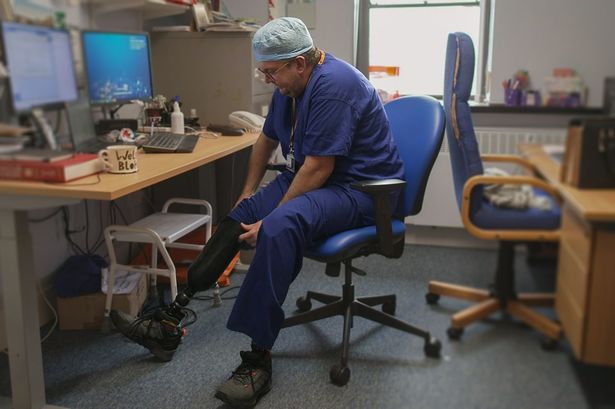
A Truro surgeon specialising in amputation who lost both legs to sepsis did make a shortlist to go into space as the world’s first para-astronaut.
Neil Hopper had his limbs removed in 2019 and was shortlisted in the European Space Agency’s search for an astronaut with a disability.
The consultant vascular surgeon at the Royal Cornwall Hospital Trust has performed hundreds of amputations in his career.
But he lost both his legs to sepsis in 2019.



After he lost his toes and much of the skin on the underneath of his feet leg amputation was the only option.
Welsh-speaking Neil now features in a new welsh-language documentary ‘Drych: Camau Tua’r Sêr’, released this week on S4C and BBC iPlayer.
The documentary followed his progress to become a para-astronaut.
Neil, a space fanatic and senior clinical lecturer at the University of Exeter, said: “When I saw the advertisement from the European Space Agency for a para-astronaut, I had to put in an application.
“The criteria were quite specific; you had to have a doctorate in engineering or medicine, you had to have a disability below the knee, and you had to speak a second language - hey, Welsh! At first my wife Rachel thought I was completely crazy!”
The double-amputee said he was advised to change careers after losing his legs in 2019, but has since made ‘vital’ contributions to the field of amputation.
Describing the experience, Neil said: “I remember imagining the operation – operations which I do all the time, and thinking that power tools were going to be used on me. That was really difficult to process.
“I was in hospital for about six or seven weeks. The physical changes in my body were fairly easy to understand, but what I didn’t understand were the psychological changes and how hard it was just to fit back into family life.
A turning point came when Neil began to use his prosthetic legs “I was starting to think I’d never be able to go back to work, I’d never be able to play football with my son, walk the dog on the beach - that’s the kind of mindset I had.
“But once I got legs, things started to change overnight, the future didn’t look so bleak.
“I was determined to go back to work. I wanted to prove that they were completely wrong.
“Throughout my career I’d always tried to imagine what it was like to have an amputation, so I didn’t expect to get the answer. I didn’t think I’d get the chance to see what it’s like on the other side of the knife. My experience has made me think more about how I communicate with patients. I believe it has made me a better doctor.”
Comments
This article has no comments yet. Be the first to leave a comment.