
IT is well-known that dozens of Cornish villages are named after saints who arrived by sea from Brittany, Ireland or Wales between the fifth and seventh centuries, writes Judith Field.
But it is more surprising to think that two share their names with a fourth-century Roman Emperor.
The villages of Constantine, near Falmouth, and Constantine Bay, near Padstow, are actually named after the sixth-century saint of the same name, whose feast day falls on March 9. According to tradition, one day Constantine was hunting a stag when it ran, terrified, into St Petroc’s shelter. St Petroc protected it, and converted the somewhat wayward young man to Christianity.
Cornwall’s Constantine was probably named after Constantine the Great (272–337 AD). This ruthless Serbian general fought his way to the top of the Roman Empire, starting from the unexpected spot of the Roman garrison of Eboracum (modern-day York).



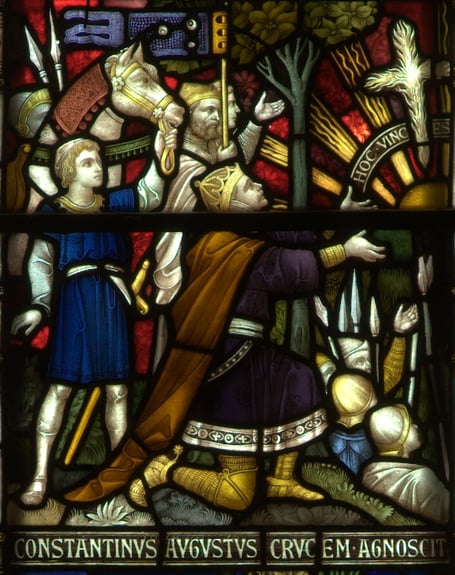
In his world, Christians were an insignificant minority, sometimes imprisoned or butchered for their faith. However, in a moment captured dramatically in Truro Cathedral’s history windows, all that was about to change.
Constantine had fought battle after battle in his struggle to gain control of the Empire, and in early 312 he was facing the climax of his campaign. Crossing the Alps with 40,000 men, he advanced towards Rome where his rival, Maxentius, outnumbered him 2:1.
Buoyed by an oracle’s prediction that “the enemy of the Romans would die that day”, Maxentius’s forces streamed out of the city to attack. Puzzled, they saw that their enemies’ flags bore the ‘Chi-Rho’ symbol of Christianity. Inexplicably - since both armies were pagans – Constantine, the would-be Emperor, had changed his religion.
The gorgeously-coloured stained glass of the cathedral captures that pivotal moment. Preparing to go into battle, we see Constantine robed in imperial purple. He glances up and sees in the sky, above the sun, a cross emblazoned with the message “In hoc signo vinces” – “In this sign you will conquer”. While his groom struggles to hang on to his startled war horse, Constantine kneels in awe. Life was never the same again – for any of us.
Constantine’s conversion, and his crushing victory against Maxentius that day, changed everything. Instead of being snuffed out, Christianity thrived. From Constantine’s twin power-bases of Rome and Constantinople (Istanbul), it spread to become the dominant religion of Europe.
In fact, it is so much embedded in our culture, that we don’t even notice any more. Christianity’s radical teaching on the equal worth of all people contradicted Roman values, and underpins our own human rights, charitable giving and even the NHS.
And did you know that we owe our Sunday lie-ins to Constantine? It was he who passed a law on March 7 in the year 321 that Sunday should be a day of rest.
Truro Cathedral’s story-telling windows capture big characters and turning points in European history. To find out more, try the new audio-guide (available at the cathedral’s Welcome Desk) or visit www.cornishstainedglass.org.uk
Comments
We've recently changed our login process. If you have an account for commenting, you will need to re-register on the login window.
This article has no comments yet. Be the first to leave a comment.