
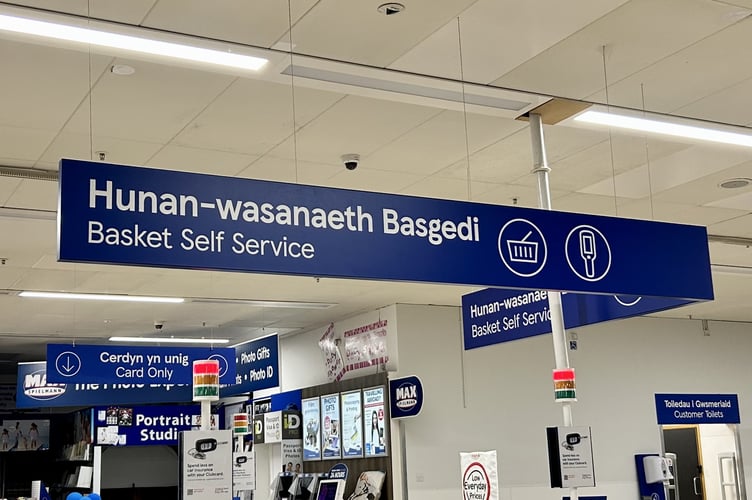
HEADLINES were made when a Helston supermarket’s bilingual signs were exposed as not Cornish but Welsh.
Shoppers were buying pysgod/fish and byd môr/seafood, when they should have been purchasing “pysk” and “boos mor”, leaving Tesco with oy/egg on its face.
Cornish speakers were quick to commend Tesco’s willingness to accommodate bilingual signage. Dr Garry Tregidga, co-director of the University of Exeter’s Institute for Cornish Studies, said: “This is obviously embarrassing for Tesco, but it is great if there was the intention to have signs in Cornish. I hope there will be replacement signs put up in the right language.”
He added: “What is also positive is that this mistake was spotted. This is a sign of the increasing number of people who are using and recognising Cornish. If anyone from Tesco needs assistance putting together the new signs, there are plenty of people who would be glad to help.”
.jpeg?width=209&height=140&crop=209:145,smart&quality=75)

In November, the government elevated the Cornish language to the same level as Welsh and Gaelic, while the Institute’s Cornish Democracy Unit has emphasised in discussions at local and national level the need for a specific political settlement for Cornwall as opposed to an “artificial solution” of 'Devonwall'.
Since its formation in 2009, Cornwall Council has been committed to increasing the number of signs bearing Cornish translations provided by its Cornish Language Office. A major milestone was reached in 2014 with the installation of the 1,000th bilingual street sign, and as of November 2022, there were more than 3,000 in place across Cornwall.
“The Government now recognises the Cornish language at the same level as that of Welsh and Gaelic, and this provides a real opportunity to bring together the cultural, economic and political dimensions of Cornish identity,” Dr Tregidga continued. “It helps communities work towards a brighter future, rather than allowing us to remain an impoverished region on the edge of the UK.”
A spokesperson for the supermarket said: “We’re sorry for this mistake and have removed these signs.” No explanation was provided as to why they had appeared in the first place, or whether they would be replaced by Cornish versions.
Comments
This article has no comments yet. Be the first to leave a comment.