
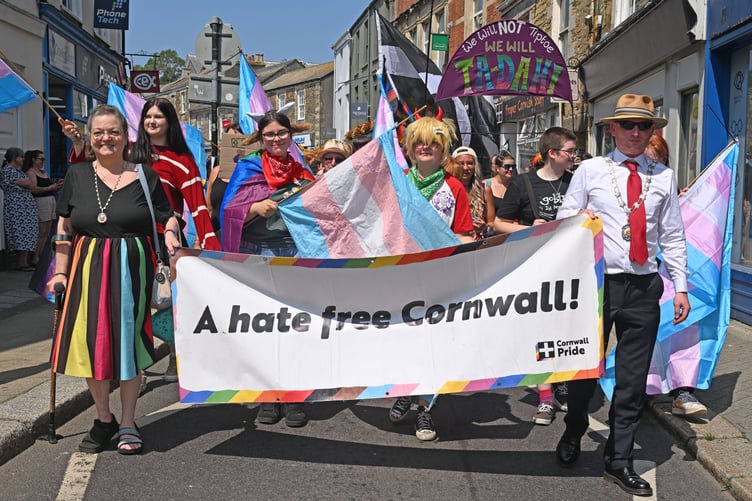
WHAT a cracking day it was for Truro Pride on Saturday. It was sunny and warm, and everyone seemed in good spirits, resulting in a colourful, lively and enthusiastic vibe.
As a journalist, I’ve attended the event several years running; and as a patient and compliant partner, I’ve been dragooned into helping the Other Half put his stand up - erecting the recalcitrant marquee, untangling the twisted bunting, smoothing out the banner that needs a good iron but never quite gets one - at Pride events all over Cornwall.
There was something slightly different about this one, though. While the parade was well attended, regulars will have noticed the piazza entertainment was considerably downsized, with a gazebo in lieu of the main stage. This was because National Lottery funding is granted specifically for areas of deprivation and no obvious/visible queer community groups: namely Newquay, Bude, St Austell and the Clays, Penzance and Bodmin.
But on top of that was a disquieting note that the celebration parade had pivoted to become a solidarity march in response to an increase in hate speech directed at diverse communities of all kinds. Operations director Aaron Monk told me he was afraid to hold his husband’s hand in public, even as “a white cis man who isn’t overly camp”, due to the boldness of homophobes both online and in person.
He revealed how, earlier that morning in Truro, he had overheard someone complaining that they couldn’t get through the city centre because of the sheer number of Pride attendees, who they referred to using a word beginning with F that was probably last uttered by Alf Garnett in the late ‘60s.
I was shocked and saddened to hear this, but not entirely surprised. One only has to look at the response my subsequent news story had on the Voice news feeds to see how much open debate there is about the role Pride plays in society.
In roughly my time on this earth, gender and sexual diversity has moved on in leaps and bounds. Homosexuality between men was legalised a few years before I was born, and same-sex marriage has been permitted since 2014. Celebrities and people in high office can be open about their sexuality in the knowledge they are protected by employment laws, and can’t be sacked simply for being gay.
And yet at times, it feels like we are still stuck in the ‘70s and ‘80s, when it was considered acceptable to use the word “queer” as an insult; and Section 28 prevented teachers from educating children in alternatives to heterosexuality, leading to some very mixed-up kids.
There are many reasons as to how and why this is happening. Times are tough, and there’s evidence throughout history to suggest that populism thrives in such eras, scapegoating groups of people who are seen to have more rights than the general populace. Cornwall Pride chief executive Matthew Kenworthy Gomes commented on how some politicians seemed “focused on division rather than bring people together”; see Reform UK-led councils keen to remove LGBTQ flags and restrict books on library shelves because they promote lifestyles other than heteronormative.
Then there’s social media, which makes it much easier to say unspeakable things behind the cloak of anonymity (or at the very least from too far away for anyone to land a punch on you), and with its beastly algorithm that enables such people to find their tribe. I often wonder if they would say the things they write, out loud to someone’s face; however, some would say this is already happening.


Add to this that the rainbow umbrella has grown quickly, and exponentially. From the first day my daughter set foot in secondary school, all the talk was about how they “identified”. Pansexual, demi-boy, furry - I had no idea what these things were, and had to remind her gently she remonstrated that old crusties need time and headspace to catch up.
But not understanding or liking something doesn’t give give anyone the right to subject someone to public humiliation or physical threat. In June, a toddler story time presented by a pair of drag queens (one the LGBTQ+ mock mayor Ginger) at Camborne Library had to cancelled “in the interests of public safety”.
Some attendees expressed concern that women who didn’t look sufficiently feminine might be challenged in ladies’ toilets. As one who has been addressed as Sir in shops, I hope it doesn’t come to that - I certainly won’t be willing to produce ID (or any other kind of evidence).
When did this kind of behaviour become OK? And how do we stop it? According to Cornwall Pride, safety is in numbers. Matthew Kenworthy Gomes pointed out how, 25 years ago, there were five Pride festivals across the UK; there are now 340. “This is progress - a step forward for every single individual,” he said.
A few years ago, a shop assistant asked me: “What about the normal people, like you and me?” I knew instinctively that we had different ideas about what was “normal”, and moved on quickly. As Matthew Kenworthy Gomes also said: “I want to be me, and I want you to be you.” Amen to that.
Comments
We've recently changed our login process. If you have an account for commenting, you will need to re-register on the login window.
This article has no comments yet. Be the first to leave a comment.