
A GENDER-critical councillor is challenging Cornwall Council’s decision to progress ten complaints against her as “discriminatory and potentially harassing”.
The council has instructed an external barrister, paid for by taxpayers, to advise the local authority on the complaints against Dulcie Tudor, Independent councillor for Threemilestone and Chacewater, near Truro.
The complaints that she breached the council’s code of conduct stem from a full Cornwall Council meeting in November – and subsequent comments made on social media by Cllr Tudor – when she asked the council’s Liberal Democrat leader, Cllr Leigh Frost, if a trans woman is a woman.
Cllr Frost would not be pushed, saying it was not down to him to decide, but that the council would obey the law.




In April 2025 the Supreme Court ruled that the legal definition of a woman is based on biological sex, in a decision which could have implications for who can access single-sex services and spaces.
Ten complaints, which are still being investigated, were made against Cllr Tudor between November 27 and December 3, 2025.
A council agenda shows that the complaints include: “It is stated that by calling trans men ‘men pretending to be women’ and drawing an equivalent with violent criminals, the subject member has breached the code”; “By posting online the subject member has been transphobic, bigoted and hurtful towards trans people”; and “By calling trans women ‘men’, she is herself bullying and insulting a protected, vulnerable group of people which is appalling behaviour and incredibly disrespectful.”
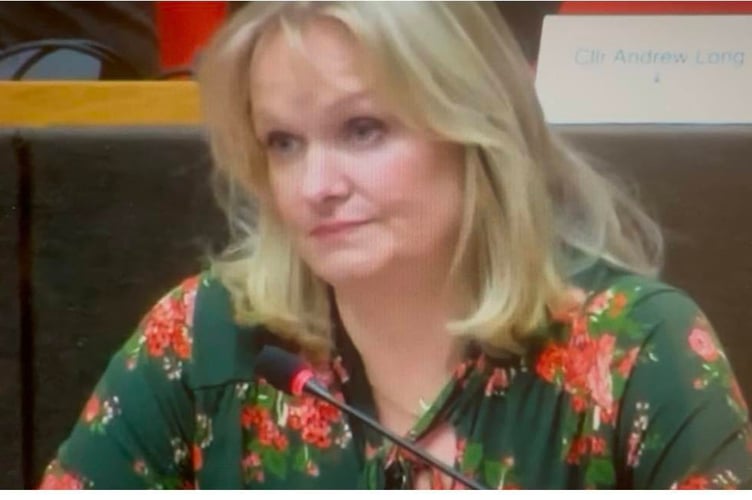
Cllr Tudor spoke during an item about ethical standards complaints at a standards committee meeting yesterday [Thursday, February 5]. She believed there had been a “co-ordinated campaign” of complaints against her.
“What requires scrutiny is why the governance officer chose to progress them at all,” she said. “All the complaints have one thing in common in that they arise from my expression of a gender-critical belief that women are biological women and men are biological men.
“That belief is lawfully held and is protected both under the Equality Act and the Human Rights Act.
“I’m asking you as a committee, under Cornwall Council’s code of conduct: should the governance officer consider the lawful expression of a gender-critical belief to be a potential breach warranting progression of a complaint? Because there is no clear legal basis for such a conclusion.
“Supported by the Free Speech Union, I’m challenging the council’s decision to progress these complaints as discriminatory and potentially harassing.”
She said that the council has instructed external legal counsel at the taxpayers’ expense to advise the local authority.
“If this report is allowed to pass without challenge by you or further inquiry into the generic issue that I’ve raised, the committee itself may reasonably be seen as endorsing or colluding in an unlawful process.”
Simon Mansell, the council’s head of governance, elections and democratic services, said the committee had adopted procedures to consider if there was a possible breach of the code of conduct. No decision has yet been made; as a result, he advised Cllr Tudor not to speak further on the matter.
Committee chair Cllr Loveday Jenkin said: “With all these things, it’s very much about how people perceive the way you’re speaking, so it’s not just about what you say but how you say it that needs to be looked at and assessed.”
Professor Meryll Dean, a non-elected independent member of the committee, said: “I have to say, when I saw there were ten complaints against this councillor and they were all based on the same subject it was rather concerning, but it is a contested area.
“I think it’s very helpful to remember this is an issue of the code versus the law. There was the Supreme Court decision about these views being legally held and I’m sure the investigating officer will be well aware of that.
“However, it seems to me absolutely critical that we bear in mind that this is a case of considering whether there’s been a breach of the code. I am assured that the process has been correctly followed. I don’t envy the person who has to make the decision.”
She added: “In this particular case, if the councillor’s gender-critical views are legally held, then by having these complaints still outstanding it seems to me there’s the potential for her freedom of expression to be limited because she may be fearful of expressing those views and, consequent of that, if she does express those views there could be an avalanche of further complaints.”
Reform UK group leader Cllr Paul Ashton agreed such matters should be dealt with urgently. He added: “Structurally we need to address this kind of issue, for fear of groups of people with a different opinion bringing issues to us which are unnecessary and outside of the law.”
Cllr Jenkin wrapped up the discussion by saying the standards committee will take into account concerns raised during the meeting the next time it reviews the complaints process.
Following the meeting, Cllr Tudor commented on her Facebook page: “What’s happening to me now is happening to councillors up and down the country. Unelected officials are using council protocols and procedures to stop elected councillors speaking about legitimate facts. It’s shameful.”
Comments
This article has no comments yet. Be the first to leave a comment.