
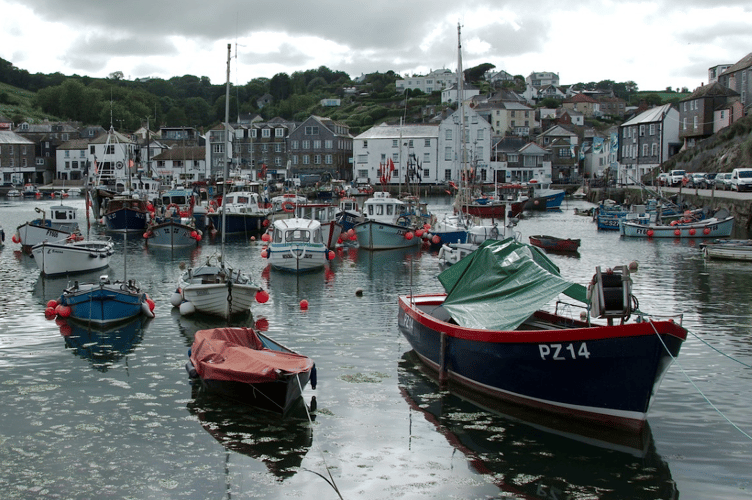
Local representatives have declared a victory for common sense after “potentially damaging” byelaws proposed by Cornwall’s Inshore Fisheries Conservation Authority (CIFCA) were scrapped at a meeting last week.
The byelaw, which was recommended by CIFCA to the Marine Management Organisation (MMO) and DEFRA for approval earlier this year, was designed to help preserve salmon and sea trout stocks from accidental bycatch in both fixed and drift nets which are used in coastal waters to target sea fish species.
However, fishing representatives in Mevagissey, the second largest fishing port in Cornwall after Newlyn, claimed this would have resulted in their fleet of small inshore boats being unable to work its traditional fishing grounds in St Austell Bay.
Steve Double, MP for St Austell and Newquay, and James Mustoe, Cornwall councillor for Mevagissey, led calls for the proposals to be scrapped based on a lack of evidence that they needed to be implemented in the first place. The pair met fisheries minister Victoria Prentis in June 2022.

.jpeg?width=209&height=140&crop=209:145,smart&quality=75)

The MMO subsequently responded with significant concerns about the byelaw, and CIFCA subsequently voted to scrap the proposals on the grounds that “the level of political interest and engagement in this byelaw both locally and at a national level has shown that there are considerable obstacles to its progress which are beyond the confines of the byelaw-making process”.
“I am pleased CIFCA saw sense following our campaign to stop the implementation of a byelaw that could have really damaged Mevagissey’s fishing fleet,” said Mr Double.
“I would like to thank the Mevagissey fishermen for taking the time to engage with us, and provide the clear evidence that was needed to help us make our case to DEFRA and the MMO that CIFCA’s original proposals were simply not acceptable.”
Cllr James Mustoe added that the scrapping of the “dubious” byelaw proposals was “good news for Mevagissey’s fishermen”. He continued: “This outcome is the right one for Mevagissey’s fishing fleet, whose livelihoods depend on being able to fish their traditional grounds, now and in the future.”
Mevagissey harbourmaster Andrew Trevarthen said: “As harbourmaster of a harbour that relies on inshore fishing, the lifeblood for the young men coming into the industry, this is good news. Many of the boats have seen little or no bycatch at all – in my own fishing career of 38 years, both inshore and offshore, I never caught one of those fish. The old byelaw made more sense, and there is also a digital app on which fishermen can record their bycatch.”
Cornwall IFCA is one of the 10 IFCAs which manages the marine inshore environment around the coast of England. The Cornwall district extends from Marsland Mouth on the north coast, around Land’s End and all the way to Plymouth Sound on the south coast, for all the waters out to the six-mile limit and includes the rivers and estuaries up to tidal limits.
CIFCA chief officer Sam Davis said that while she understood the bycatch of salmon and sea trout was “infrequent”, the IFCA nevertheless had a “legal responsibility” as an IFCA to take it into consideration when making byelaws.
The new byelaw was intended to replace one from 2010 which was written differently and used slightly different measurements. “Ultimately the decision was made that there was still some understanding of the socio-economic information needed to support it,” said Miss Davis. “As a result, the decision was made not to go forward with it, and we are back to using the 2010 byelaw, which I believe will be sufficient at this time.”
The new byelaw had been in development for seven years. “It was a long time, but sometimes byelaws do not end up being confirmed,” said Miss Davis. “That’s the process – we are democratically accountable to our committee, and the byelaw was subject to quality assurance, the end result being that it didn’t go for confirmation.”
Comments
This article has no comments yet. Be the first to leave a comment.