
-Rev-Canon-Scott-Smith-David-Berwick-chairman-of-t.png?width=455)
A COMMUNITY is seeing the fruits of its labour after cider created from apples harvested from an ancient orchard they restored at a convent near St Mawgan won a top award.
Residents, the Carmelite community at Lanherne Convent, volunteers and traditional cider makers helped create Lanherne Convent Cider, which was awarded gold in the open dry cider category at the Royal Cornwall Show and the overall best in show.
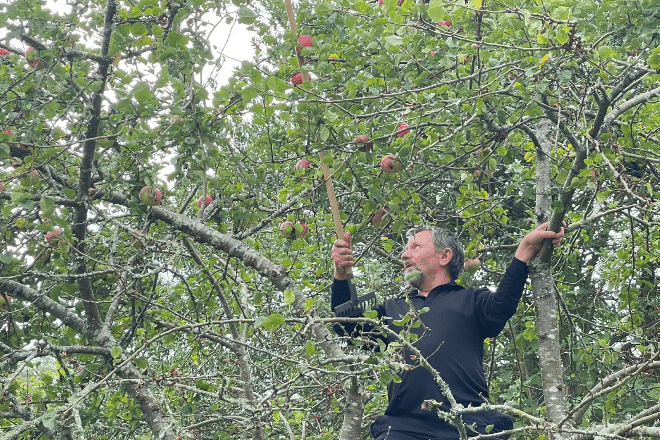
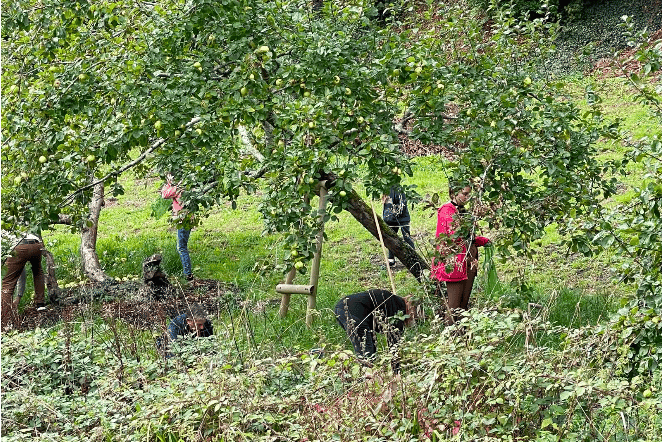
The group has been restoring the historic orchard for the past six years, which has included clearing brambles, pruning the orchard trees and reopening pathways.


.jpg?width=209&height=140&crop=209:145,smart&quality=75)

The orchard had previously not been harvested on a significant scale since 1949.
Ed Stein, the eldest son of celebrity chef Rick Stein, saw the orchard’s potential and approached Father Anthony Pillari, then chaplain of Lanherne, in 2019 about a potential restoration project as it had become overgrown following many years of neglect.
Ed, who leads on all building and refurbishment projects within the Stein business, said: “As I worked among the trees and sampled the fruit, I discovered that many of the older specimens were traditional cider apple varieties.
“Fr Pillari encouraged the idea of developing a cider from the fruit.”
Tom Bray of Haywood Farm Cider, agreed to work with the volunteers to create a specialist small-batch cider.
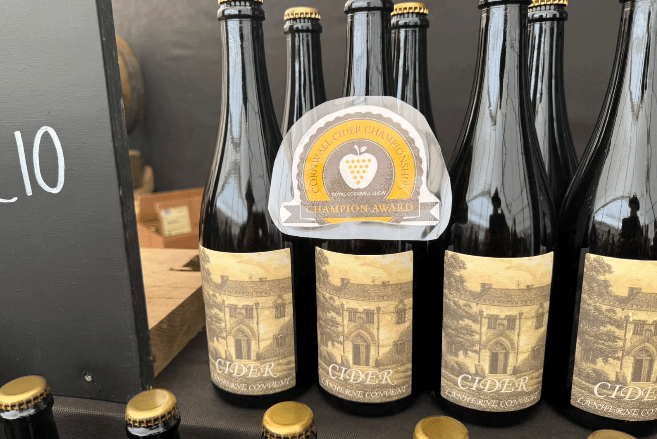
The first harvest gathered in 2020 produced more than 950 bottles of Lanherne Cider, which marked the beginning of the “wider orchard revival.”
One of their first successes was seeing Lanherne Convent Cider awarded silver in the open dry category at the Royal Cornwall Show in 2023. Their apples juice has also won awards at the prestigious event.
The orchards form part of the historic Lanherne estate, home to an enclosed Carmelite community since 1794.
Over recent years, fruit has once again been gathered from four orchards associated with the estate, including a restored orchard cared for by local resident Peter Parkinson and another managed by the Friends of Lanherne Pound House.
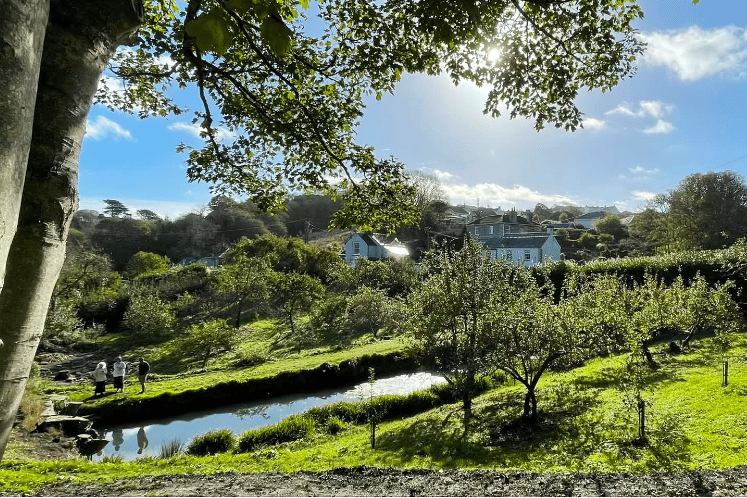
The project has also seen the restoration of an estate pond, support for pollinators through beekeeping, and the preservation of a landscape that has long been part of village life.
The restored pond is now home to a variety of wildlife including Moorhen, Mallard and dragonflies.
Pete: said: “It was a few years ago when Ed Stein asked me to offer up the apples in my orchard for cider making.
“It was always my intention to do something on my own but I never got around to it. Ed and I spoke about the qualities of my apples as he had seen them for himself while maintaining the convent water supply.
“I’ve always been interested in wildlife and conservation and local history.
“As a boy walking down the hill through the village I would often look over the roadside hedge to see all the apple trees next to the Convent pond.
“From the 1907 Ordnance Survey maps I was aware of other orchards that had existed within the Lanherne Estate.
“St Mawgan generally had a lot of orchards, every farm seems to have had one.
“In early 2009 I was walking past Lanherne Barton Farm and Mr and Mrs Hawkey called me in to speak to me they had bought the farm from the convent.
“Both Mr and Mrs Hawkey knew of my interest in apple trees and said that the wood and orchard which had been part of the farm was for sale.
“They gave me a telephone number for the convent land agents and the rest is history.
“What I didn’t realise was that the wood and orchard hadn’t been maintained for many decades.
“With a friend it took six weeks just to make a path from the gate to the end of the orchard.
“I kept looking back at the 1907 map and we achieved our aim at restoring the orchard. Not quite exact but pretty close. My dream of owning my own orchard had become a reality.
“What do traditional orchards mean to me? Quite a lot really. St Mawgan has a long history of apple growing as apples were an important source of vitamin C.
“If you keep with local traditional apple varieties this keeps the history of the local orchards alive.”
Reverend Canon Scott Smith, the chaplain of Lanherne. said: “The award is really recognition of all the hard work everyone has done and testament to the quality of the orchard after all these years of being unused.
“Everyone who has been involved in the restoration of the orchard is really pleased.
“What makes the story unusual is that it is about much more than cider.
“The story is ultimately one of heritage, community and renewal in a little-known corner of Cornwall that many thousands of travellers pass each year without ever discovering.
“It is the story of how a historic landscape, once central to the life of an estate and a village, was brought back to life through the efforts of local people, volunteers, traditional craftspeople and the Carmelite community that has called Lanherne home for more than two centuries.
“Most of all, it is a story about the enduring value of places that might otherwise have been forgotten.
“Lanherne’s history reaches back far beyond the modern era.
“For centuries the estate formed part of the life of St Mawgan and the surrounding countryside.
“Long before it became home to the Carmelite community, Lanherne was the seat of the Arundell family, one of Cornwall’s most important Catholic families. The house, the surrounding farmland and the orchards all formed part of a working estate whose rhythms were closely tied to the seasons.
“Those involved in the orchard restoration understand the award represents something larger than cider-making excellence.
“It represents the success of the restoration itself.
“Without the orchards, there would have been no cider. Without the community effort, there would have been no orchards. The award was therefore not simply recognition of a drink. It was recognition of an entire landscape brought back to life.
“The story of the Lanherne orchards is still being written. Every harvest adds a new chapter.
“Each bottle of cider, each bottle of apple juice and each jar of honey reflects not only a particular season but an ongoing commitment to stewardship.
“The orchards are no longer silent.
“They are once again fulfilling their original purpose while supporting wildlife, strengthening community connections and preserving an important part of Cornwall’s agricultural heritage.
“Their revival demonstrates that conservation need not mean placing landscapes behind glass. Sometimes the most effective way to preserve a historic landscape is to help it become productive once again.
“For more than 70 years the orchards continued to bear fruit while much of that fruit went unused. Today that fruit is once again gathered, shared and enjoyed. In doing so, the orchards remind us that some of the greatest acts of conservation are not acts of discovery.
“They are acts of renewal.
“The Lanherne orchards never truly disappeared. They simply waited for a community willing to bring them back to life.
“The community is welcome to visit the convent grounds.”
People interested in sampling Lanherne Convent Cider it is available to buy from Rick Stein’s Deli in Padstow, St Mawgan Village Stores and Retorrick Mill.
Comments
This article has no comments yet. Be the first to leave a comment.