
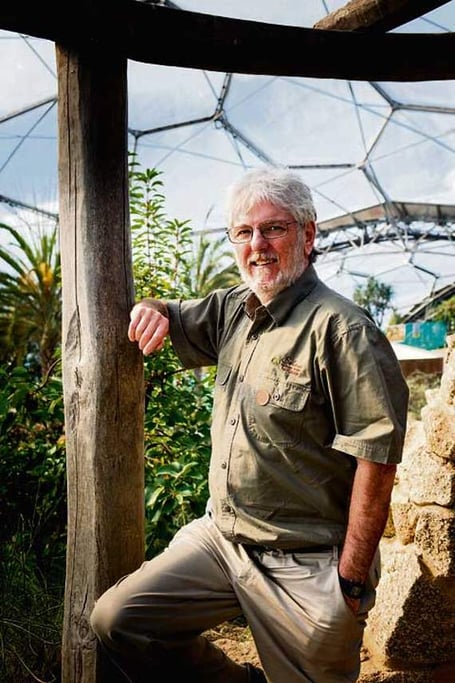
AS THE Eden Project marks 25 years and more than 25 million visitors, its Cornish co-founder Jonathan Ball has suggested it might be seen in a broader light as “something akin to a guardian spirit of place, carrying Cornwall’s values outward to what can feel an increasingly uncertain world”.
Mr Ball was pictured at the attraction’s 25th anniversary celebrations, singing Harry Glasson’s anthem Cornwall My Home beneath the iconic biomes alongside the Rt Rev David Williams, Bishop of Truro. It was, he said, “a magical moment for Cornwall and all Cornish people, that spoke of place, memory, belief and belonging, the very foundations upon which Eden was first imagined”.
It's the same spirit that has informed his proposed pilot programme to secure the future of some of rural North Cornwall’s remotest churches. Born and bred in Bude, architect Mr Ball - co-creator of the Eden Project together with Sir Tim Smit, from its first concept stage – presented his ideas for securing the future of these “memory palaces” during Bude Literature Festival, on Thursday (May 14) at St Michael's Church.
The vision goes by the working title of “From Hawker to Hardy”, in reference to two of the churches: Morwenstow, whose vicar Robert Stephen Hawker wrote The Song of the Western Men, better known as Trelawny; and St Juliot’s in Boscastle, famed for its connection with author Thomas Hardy who worked on its restoration and married the rector’s sister-in-law.



They are joined by sacred buildings in Bude, Stratton, Poundstock and Launcells in what Mr Ball describes as “a coherent, beautiful and manageable geography: small enough to succeed, yet rich enough to inspire”.
The project draws upon Mr Ball’s belief in Genius loci, a Latin phrase meaning “the spirit of place”. He explained: “It describes the unique atmosphere, character and presence that make one place different from all others. In Roman times it was understood as a guardian spirit, and today we use it to express something just as profound: the way landscape, history, memory, faith and community combine to form the soul of a place.
“Rural North Cornwall holds this quality in abundance. This is a landscape that teaches attentiveness, humility and continuity. It is not just scenery - it is inheritance.”
The Memory Palaces pilot programme would see the churches transformed into living centres of story, identity, wellbeing and place-based experience, creating a “dip-in, dip-out” pilgrimage across the district, with each church a point of encounter with history, literature, faith, landscape and community. Visitors would be welcomed by trained volunteers telling the story of their church and its setting, saints and people.
Mr Ball continued: “For any inheritance to remain alive, it must be allowed to speak to its own time. A century ago, these churches stood at the very centre of their communities: socially, spiritually, culturally and morally. They were where life gathered and belonging was affirmed.
“Today they need a new voice, not to replace the old, but to speak to the needs and hopes of our own age: wellbeing, story, welcome, reflection and shared responsibility.”
Comments
We've recently changed our login process. If you have an account for commenting, you will need to re-register on the login window.
This article has no comments yet. Be the first to leave a comment.