
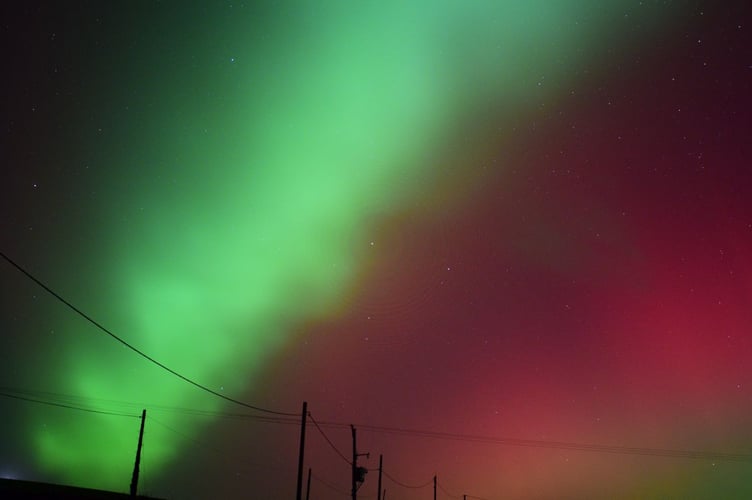
JANUARY saw one of the best displays of Northern Lights for many a long year, and by the time this goes to press, we will have marvelled at (or more likely missed) seeing the Moon cross in front of the Pleiades on January 27.
But as I write, another storm is making flooding inevitable. The rainy season is well and truly here – and yet, with a clear night sky, February is one of the best months for bright stars on display.
I suspect that the Sun is not yet done with us, as it is very active at sunspot maximum. Our star is covered with spots at the moment, and they are the source of the Coronal Mass Ejections etc produce the aurora when they interact with the Earth's atmosphere.
The phases of the Moon are as follows: Full Moon, February 1; Last Quarter, February 9; New Moon, February 17; First Quarter, February 24. Native American tribes named this month's full moon the Snow Moon, after the characteristic heavy snowfall.



Venus can be seen all month after sunset. With a telescope, it should be possible to see its changing phases (you may need to put a moon filter on the eyepiece to reduce the glare). Jupiter remains in Gemini and is very bright. It’s a good time to spot the four major satellites as they change position every night.
Constellation wise, the southern sky is dominated by Orion, whose belt has been copied in Egypt (the three pyramids of Giza) and Cornwall (the three stone circles of The Hurlers). Its neighbours include Canis Major, with Sirius, the Dog Star, the brightest in our night sky; Canis Minor and Taurus, making this a very bright part of the sky.
Brian Sheen runs the Roseland Observatory at Truro High School for Girls. A Telescope clinic will be held on Sunday, February 8 at The Astronomy Hub; to attend, email [email protected].
Comments
We've recently changed our login process. If you have an account for commenting, you will need to re-register on the login window.
This article has no comments yet. Be the first to leave a comment.