
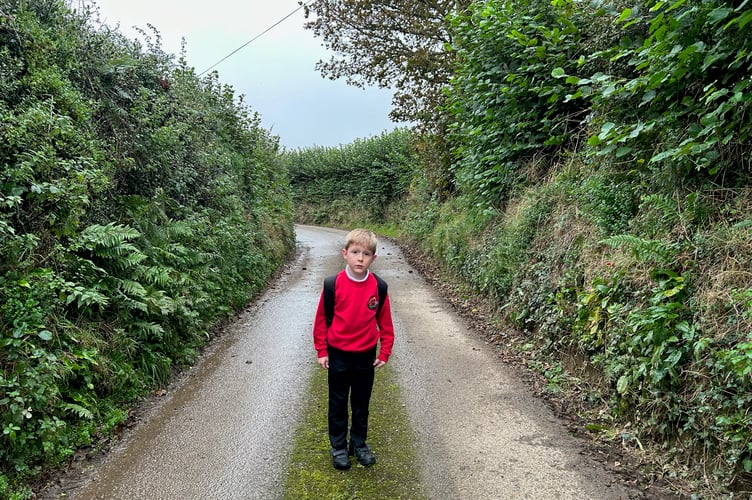
A furious father is battling with Cornwall Council to reinstate his eight-year-old son’s free school transport after being told he could walk the three-mile distance along country lanes.
Barkley Sharp lives in Mitchell and attends his nearest primary school in Summercourt. Because it is over two miles away, he was entitled to publicly-funded transport until the end of Year 3, in the form of a taxi shared with other pupils in similar circumstances.
However, from Year 4, council policy stipulates that only children who live further than three miles from their nearest school are eligible for free transport. Since September, Barkley’s parents have been forced to find alternative means of arrival at school.
His father, Ashley, has been in dispute with the council since June in a bid to overturn the decision. He asserts that while the family home is 2.7 miles from Summercourt primary school – 10 per cent under the statutory requirement – the council’s suggested walking route is not safe, despite its detailed assessment which Ashley claims is “not a true reflection” of the journey.
.jpg?width=209&height=140&crop=209:145,smart&quality=75)
.png?width=209&height=140&crop=209:145,smart&quality=75)
While vehicles would travel the distance along the A30, Barkley’s route would take him along back roads. “Because there is less traffic, people think it’s safer,” said Ashley.
“But there are umpteen farm entrances, meaning there will be machinery. A distribution depot opens here in October, bringing HGVs from all over the country. There are no pavements and no street lights. If a tractor comes by, there is very little passing space for a pedestrian.
“The route would take an adult an hour to walk. Barkley is a little eight-year-old, so it might take him even longer, meaning he’d be leaving home between 7am and 7.30am, potentially in the pitch black.
“In winter, he could be doing this in all weathers, and all temperatures. If hearrives at school soaking wet, he will have to spend the whole day like that.”
Ashley and wife Tara appealed the decision in June, confident of success. “I was pretty relaxed, thinking that as soon as someone looked at it, they would realise that no human in their right mind would consider this a suitable walking route for an eight-year-old,” said Ashley. “But the policy is being adhered to – it’s a case of ‘computer says no’.”
A second opportunity for appeal is scheduled for November. In the meantime, the Sharps are getting Barkley to school “by hook or by crook”. Family members have been called in, with some travelling from Devon to help out.
“School opens at 8.35am,” says Ashley. “Tara is a supply teacher and has to be at her own school for 8am. I work in Wadebridge, and would be constantly late for work if I left after dropping him at school at that time.
“The alternative is wraparound care in the morning and afternoon, which would cost a fortune – so it isn’t just about inconvenience, but also financial hardship.”
He added: “It’s so frustrating. From my driveway, I can see houses in Mitchell that are eligible for council transport to school. The taxi is still driving there.
“All I ask is that someone from the council walk this route in the dark, and consider whether they would want their own children to be doing that.
“My younger son, Sonny, is nearly three. In a few years, I can see us having to do this all over again. There are 94 children in Mitchell, and a lot of them will face this when they reach Year 4.”
A spokesperson for Cornwall Council said: “While we cannot comment onindividual cases, any parent who is unsuccessful in their application for free home-to-school transport through the council does have the right to appeal. Within this appeal, the parent can include any concerns they have about the suitability of the walking route identified for their child.
“When reviewing the appeal, the council will carefully consider the case put forward and where necessary will commission further pedestrian route assessments (PRA) to be undertaken independently to assess the suitability of walking routes.
“All PRAs are carried out in accordance with the council’s PRA Policy, which follows the national Road Safety GB guidelines and the relevant case law.”
Comments
This article has no comments yet. Be the first to leave a comment.