
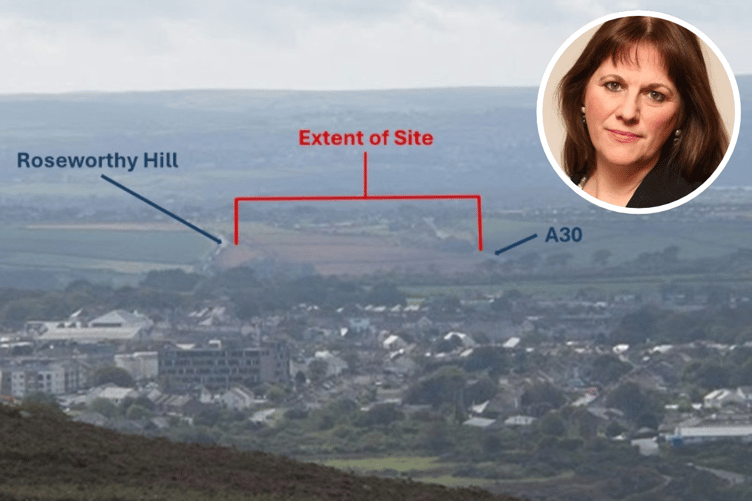
A WOMAN in Cornwall who is waging a ‘David and Goliath’ battle against the council has raised over £26,000 towards a High Court hearing next week.
Kim Hillier has said that Cornwall Council was wrong to approve a planning application for a green waste facility, which she and other concerned residents believe will lead to the “inappropriate industrialisation” of the countryside.
The council’s strategic planning committee approved the proposal by The Green Waste Company in December 2025 to build a wood, composting and green waste processing and recycling facility, which will include a commercial scale agricultural building, attenuation pond, weighbridge, access and parking on land at Roseworthy Hill, Connor Downs in west Cornwall.
The local firm currently has two recycling sites at Higher Brynn, near Victoria, and Splattenridden Farm, near St Erth. Splattenridden receives green waste from five council-run Household Waste Recycling Centres (HWRC) sites at St Erth, Pool, United Downs, Falmouth and Helston and four local town councils (Hayle, Penzance, Camborne and Helston).
In its original application, the company stated: “For reasons of logistics and capacity, it is proposed that, apart from the St Erth HRWC and Penzance Town Council sources, all other waste would be sent to the proposal site at Roseworthy. This would greatly improve the current services provided by The Green Waste Company and, importantly, will greatly reduce miles travelled every year transporting the waste.
“Whereas expansion of Splattenridden and other sites was considered, these options were discounted for logistical reasons. The proposed site is conveniently located on low-grade agricultural land owned by the applicant. It has immediate and safe highway access.”
However, it was met with an avalanche of opposition locally, including 138 objections from local people, businesses, charities and Gwinear-Gwithian Parish Council, with just one comment in support on the council’s planning portal.
Mrs Hillier formed the Stop Roseworthy Green Waste campaign in an attempt to overturn the council approval. A High Court judge granted permission for a judicial review of the decision to proceed on four legal grounds, with two more to be reconsidered, at a two-day hearing on December 1 and 2. It will include the consideration of environmental impacts, statutory environmental consultation and whether important environmental safeguards were properly applied.
In early September, the legal fighting fund stood at £11,300, but since media coverage that has rocketed to more than £26,000.
Mrs Hillier said: “This has been an extraordinary battle and I want to thank every single person who has stood with me and supported this fight. There is still a mountain to climb. With a target of £50,000, we urgently need more people to join us and help close that gap.”




She added: “This is not just a local fight for a field outside a rural village. This battle goes even further. It is about so much more than stopping a major industrial waste development in our own backyard.
“The fight is not anti-green; it is not against recycling or composting. Quite the reverse. The battle is to prevent putting a major industrial waste development in the wrong place, without properly confronting the consequences for the people, communities, countryside and natural environment that must live with it. Forever.
“We are contesting the inappropriate industrialisation of an exposed rural hillside, permanent soil sealing with a vast concrete platform and a huge, intrusive industrial building wholly out of keeping with our open countryside, thousands of additional HGV and vehicle movements on our rural and village roads already groaning under the weight of traffic, and the potential consequences for our waterways, vulnerable wetlands and precious wildlife.”
Cornwall Council and The Green Waste Company have been approached for comment. The company did not wish to comment previously, but did question some of the figures mentioned by the Stop Roseworthy Green Waste campaign, particularly around the number of vehicle movements and how many of them would be made by HGVs.
Comments
We've recently changed our login process. If you have an account for commenting, you will need to re-register on the login window.
This article has no comments yet. Be the first to leave a comment.