
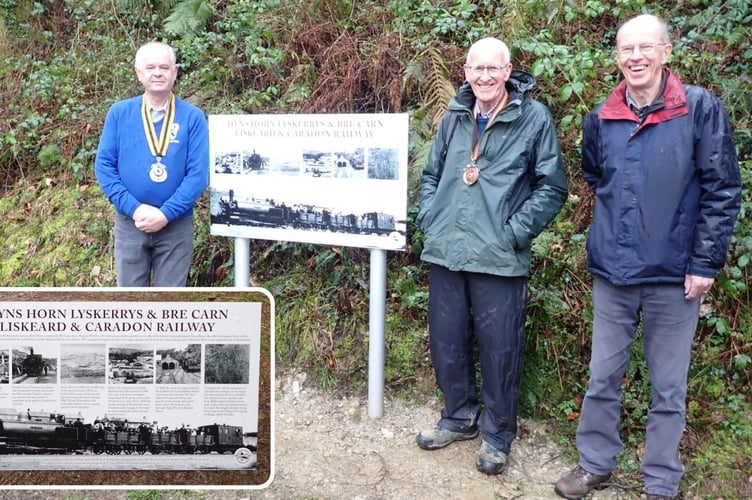
A FORGOTTEN chapter of Cornwall’s industrial story has been brought back into the spotlight with the unveiling of a new heritage information board in High Wood, Liskeard – marking the route of a railway that once helped power the county’s mining boom.
The quiet bridleway that now winds through the trees was once the track bed of the Liskeard and Caradon Railway, an ambitious Victorian engineering project that opened in 1846 to transport copper ore and granite from the rich mining district of Caradon Hill.
At a time when Cornwall was a global leader in copper production, the railway played a vital role in moving valuable minerals from the moorland heights to market. Ingeniously designed, much of the route ran downhill from Caradon through Minions to Moorswater, allowing loaded wagons to travel by gravity alone. It was a simple but effective system that reduced costs and maximised efficiency.
Once at Moorswater, the ore and stone were transferred onto canal boats bound for Looe. The return journey, however, required considerably more effort. Empty wagons were hauled back up to the mines by horsepower – a slow and demanding task that reflected the physical challenges of early industrial transport.




Everything changed in 1860 when steam locomotives replaced horses on the line, dramatically increasing capacity and reliability. The old canal route to Looe was soon replaced by a railway extension, allowing trains to run directly to the seaport. From there, ships carried Cornwall’s minerals across Britain and around the world.
For decades, the line was a symbol of enterprise and progress. But mining fortunes began to wane. In 1909, the Great Western Railway took over the operation, integrating it into the wider rail network. The reprieve was short-lived. By 1917, amid declining copper production and wartime pressures, the line closed. The rails were lifted, and the once-busy track fell silent.
Over the following century, much of the lower route disappeared beneath farmland, roads and development. Occasional remnants offer fleeting reminders of its industrial past. Around Caradon Hill, the line can still be traced on maps and in the subtle embankments etched into the landscape.
The most complete surviving section is the mile-long stretch through High Wood. Now a peaceful bridleway open to walkers and riders, it offers a clear physical link to the railway’s story.
Determined this heritage should not be forgotten, the Liskeard Old Cornwall Society worked with the woodland’s owners, Protect Earth, to design and install a new information board alongside the former track. The sign provides visitors with a concise history of the railway and its importance to Liskeard and the surrounding mining communities.
The board was recently unveiled by Nev Meek, president of the Federation of Old Cornwall Societies. He was joined by Brian Oldham, president of Liskeard Old Cornwall Society, and local transport historian Peter Murnaghan.
For those involved, the project is about more than preserving facts. It is about reconnecting the present-day landscape with the industry that once shaped it – and ensuring that, even where the rails have vanished, the story of Cornwall’s mining railway continues to run strong.
Comments
We've recently changed our login process. If you have an account for commenting, you will need to re-register on the login window.
This article has no comments yet. Be the first to leave a comment.