
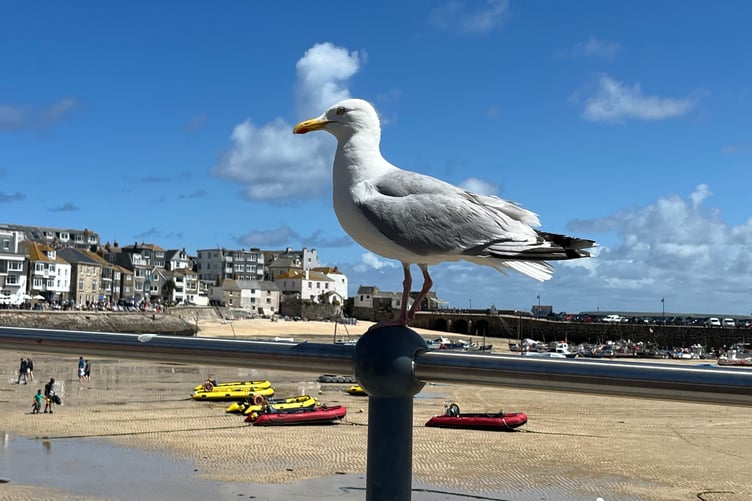
IT’S lunchtime, and we’re chowing down with my in-laws. The Other Half (OH) has snagged the best seat in the joint, by the window overlooking the garden. My father-in-law (FIL) is frying up some tasty Japanese gyoza dumplings in his wok. My mother-in-law (MIL), meanwhile, is chastising her most treasured guests, who are strictly limited to patio seating and are volubly demanding their nosh like a pair of restaurant customers from hell.
MIL has long been feeding some gulls who have pretty much taken up residence in her back yard. During the heatwave, you’ll find them cooling their feet in the bird bath. At any given time of day, they await their scraps with varying levels of patience; siting on the fence, beady eyes trained on the patio door; on the paving slabs, beak ready to peck on the window if service is lagging behind.
On previous occasions, they were bold enough to saunter into the house; now, in order to have the door open to let in some breeze, the entrance is guarded by a wooden meerkat and an array of bottles and vases.
MIL is trying to train them to accept food at particular times: breakfast, lunch and dinner. OH jokingly suggests we write out a menu in cursive on a little chalk board, French bistro-style: last night’s rice, stale bread with a soupcon of mould.
We regard all this with a mixture of amusement and mild concern. Others would be less tolerant. Stuart Price, who lives in Pentire in Newquay, made our headlines this week after calling on Cornwall Council to introduce a bylaw that would make it illegal to feed gulls when such an act is causing nuisance behaviour. Mr Price was moved to speak out by feeding incidents in his neighbourhood that resulted in his washing regularly being covered in bird mess.
To his dismay, he discovered that while Cornwall Council can penalise or even ban people for feeding seagulls in public places such as beaches, promenades and harbours, through the means of Public Space Protection Orders, when it comes to private property - such as a back garden or window – the authority can only advise against feeding wild birds in the interests of hygiene and neighbourly consideration; there is no specific law to stop such indulgences.
“For the last six years I’ve been living between two prolific bird feeders, and my poor washing line is sandwiched in the middle,” Mr Price complained. “Both neighbours are animal lovers, and neither are willing to stop.
“The mess and noise of having seagulls flying back and forth over your garden or just sitting relentlessly begging for food is such a nuisance that I thought there must be some local restriction on encouraging this behaviour, but there is not.”
Describing the gulls as “absolute hooligans”, Mr Price added: “Introducing wildlife to fast food is for our own gratification, reducing them to performing animals. It is not doing them any favours; we are probably killing them with kindness.”
Conservationists would agree with him on that point. The RSPB respectfully reminds one and all that gulls are “incredibly resourceful and are perfectly capable of finding their own food”.
Cornwall Wildlife Trust adds that many gull species, including the herring gull – “seagull” being a catch-all term rather than an actual species - are classified on the UK Red List for conservation, and natural foraging is vital for long-term species survival. Rather than bread and other scraps from the human diet, gulls in the wild are more likely to eat fish, molluscs, crustaceans and earthworms, as well as hunting terrestrial prey like insects, small rodents and birds.
Gulls are deeply divisive. Anyone who has ever been to a seaside town like St Ives, with its plentiful walking street food, will have had an ice cream or pasty half-inched by a canny avian. It’s certainly irritating, and their talons can take a chunk out of your cheek.
And yet, the winged assailants have their following. There’s even a Seagull Appreciation Society on Facebook, and when a holidaymaker took matters into his own hands – or feet – and recently gave one crafty culprit a literal kicking, the internet exploded with indignation.
Cornwall Council advises against feeding gulls to prevent vermin problems and to avoid conflict with neighbours. This would not be an issue for MIL; when she goes on holiday, the next-door neighbour (NDN) is primed to take over kitchen duties, much as one would arrange for someone to feed the cat. NDN is only too happy, as she has cultivated her own brood of beautiful white doves who perch on her porch in hope of the next scattering of crumbs.
What do you think? Feed the birds, tuppence a bag? Or let them find their own supplies and leave ours well alone? Be sure to let me know at [email protected]
Comments
We've recently changed our login process. If you have an account for commenting, you will need to re-register on the login window.
This article has no comments yet. Be the first to leave a comment.