
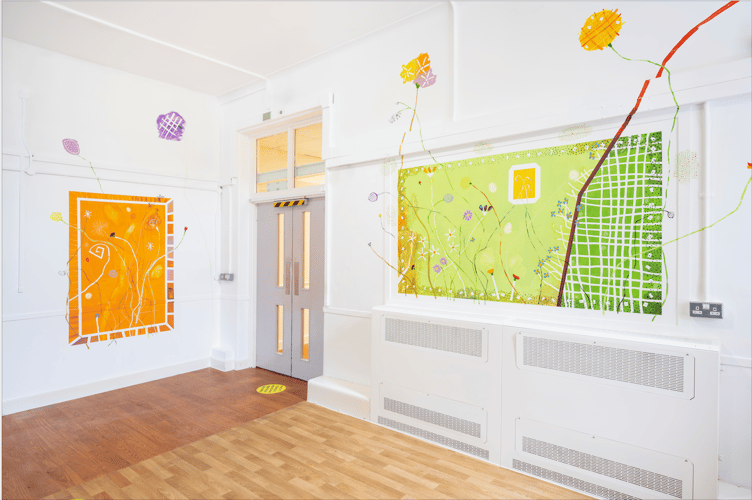
Cornwall’s artists have been commissioned to co-produce new works for the inpatient mental health wards at community hospitals in Bodmin, Camborne and Redruth.
The initiative is a partnership between Cornwall Partnership NHS Foundation Trust and Hospital Rooms, a charity that aims to make the mental health hospital environment less cold and clinical at a time when patients are vulnerable, by transforming spaces with high-quality artwork.
The art will be developed in collaboration with patients and staff, and will mark the beginning of a longer-term strategy to put culture and creativity at the heart of mental health care in Cornwall.
In Bodmin, it will cover Bowman, Fletcher and Harvest Wards, where patients aged 18+ stay between two weeks and two years, with diagnoses ranging from severe depression and personality disorder to schizophrenia, mania or psychoses. In Redruth, the project will work with Carbis and Cove Wards, acute psychiatric wards for age 18+ and 65+ respectively.



The 12 commissioned artists will each lead three imaginative and adventurous workshops, providing a space for creations and conversations to unfold that will inform the artworks to be made for the wards.
Most workshops will take place at the hospitals, giving artists the opportunity to get to know the ward community, develop a deeper understanding of what life is like in hospital, and explore the impact their artwork could have.
A few will take place at Tate St Ives and into Bodmin. Some will be for patients and ward staff, offering an opportunity to spend time making art in a creative setting; others will be aimed at members of the local community with lived experience of mental health services. Both will aim to ensure the new artworks have a relationship with those who encounter them.
Hospital Rooms has commissioned a roster of acclaimed artists to bring a breadth of ideas and sensibilities to the project. They include Sovay Berriman, a multi-disciplinary artist with a studio at Krowji.
She works primarily in sculpture and drawing, in media ranging from copper casting to rubbish and found materials, and is planning to produce something “colourful and exciting”, inspired by the minerals and gems to be found within Cornwall.
“I feel really honoured to be able to contribute,” she says. “People I love and care for use Cornwall’s mental health services and have had connections with these wards in the past, so it’s of personal importance to me to bring something joyful and pleasurable to people who are using those environments now.
“It’s my firm belief that we are sensory, creative, emotional beings.
“Art provides us with opportunities to explore our responses to the world we engage with every day, in a variety of different ways and from different viewpoints.”
Also producing work for the project are Anna Barriball, Maria Christoforidou and Viviane Vaux, Phillippa Clayden, Janet Holland, Chantal Joffe, Alvin Kofi, Abigail Reynolds, Ro Robertson, Ben Sanderson, Melanie Stidolph and Lucy Willow.
Hospital Rooms will also organise visits to museums and galleries across Cornwall with the aim of encouraging engagement with these spaces. They hope to leave a legacy where access to arts and culture is central to the treatment of mental illness in Cornwall.
Debbie Richards, chief executive of Cornwall Partnership NHS Foundation Trust, says: “Art is so important – it helps our wellbeing in many different ways and I am delighted we are part of this exciting project.
“As well as creating art for some of our inpatient wards, I hope it will create a lasting legacy which will benefit people for years to come.”
Anna Testar, Hospital Rooms’ senior project curator, adds: “Cornwall is an exceptionally creative place, and the passion and enthusiasm from both Cornwall Partnership NHS Foundation Trust and the creative community to contribute and collaborate has given this project the best possible start.
“Over the next year, we hope to build strong and lasting ties between the creative and healthcare sectors, improving access to art and creative activity and ensuring that it plays a central role in the recovery of people with mental health difficulties.”
Comments
This article has no comments yet. Be the first to leave a comment.