
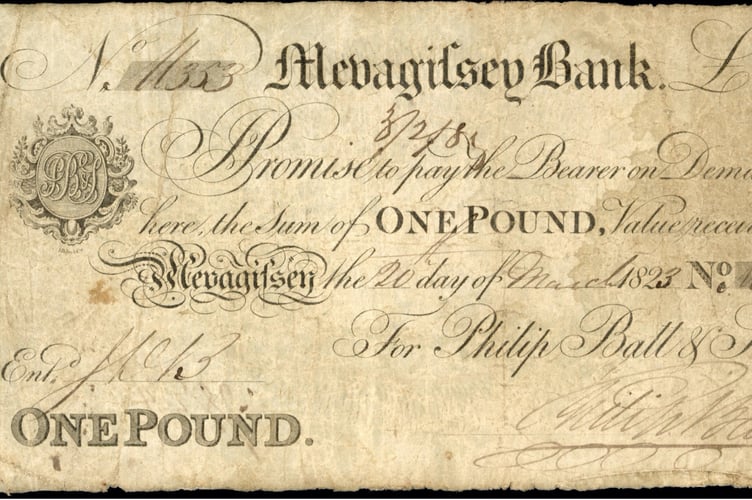
AN historic Mevagissey banknote that is set to go under the hammer on Thursday, January 29 is expected to sell for between £80 to £120.
The 323-year-old £1 note from Mevagissey Bank is lot 103 in a banknote auction being presented by Stanley Gibbons Baldwin for the first time in several years.
Philip Ball started the Mevagissey Bank in south Cornwall in 1807, but it collapsed in November 1824, shortly after the note was issued.
Mevagissey relied on the pilchard trade which was declining by the 1820s and when the bank failed, there was much hardship on a town already on its knees and many fishing boats had to be sold along the south coast.
.png?width=209&height=140&crop=209:145,smart&quality=75)



Smuggling became more prominent to the town at this point as the lawful activity of fishing became more difficult to earn a living from.
One of the more interesting and stronger sections of banknotes being sold at the auction are British Provincial banknotes. The provincial private banks of England provided the invaluable function of supporting and promoting the Industrial Revolution.
The Bank of England really confined itself to the City of London and with very little exception, never established any branches outside of the capital. Each provincial bank could issue its own banknotes, although legislation in 1777 prohibited banknotes under £5.
In 1797, this was reduced to £1 or one guinea due to the financial strains of the war with France. After the war, this was raised to £5 in 1825 and no lower denominations were issued until the next century.
In 1844, there were 442 different banks operating in England and Wales and at that point it was legislated then that no more private banks could be set up.
Provincial banknotes such as the Mevagissey note are a real and tangible link with the past. For more information on the auction, visit: sgbaldwins.com
Comments
We've recently changed our login process. If you have an account for commenting, you will need to re-register on the login window.
This article has no comments yet. Be the first to leave a comment.