
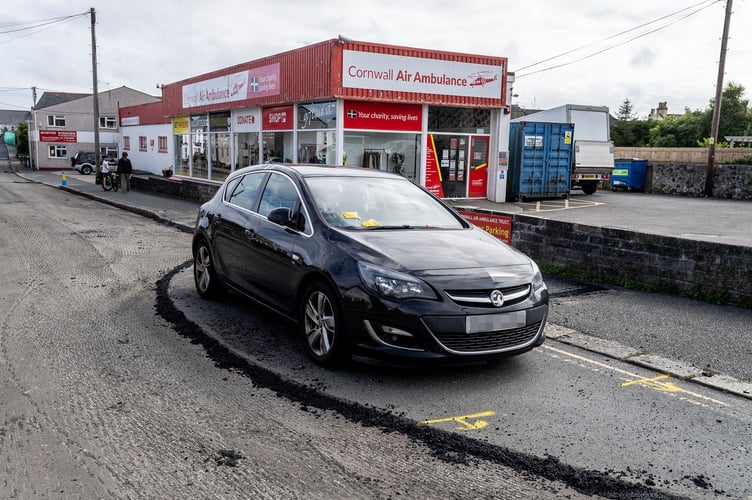
Cornwall Council’s highways division staff were forced to work around a parked car which caused a major obstacle to scheduled road surfacing works on Monday.
The black Vauxhall had reportedly been left in Clifden Road for a length of time on double yellow lines outside the Cornwall Air Ambulance charity showroom, and had multiple parking tickets.
Giselle Manning, relief manager for the Cornwall Air Ambulance store, said the car had been there “two or three weeks”.
“It looks like it might have broken down, and rather than making the effort to push it off the road, the driver has just abandoned it two feet from the kerb,” she added. “Apparently it can’t be moved legally for six weeks. Obviously it’s annoying for the workmen, who are having to resurface around it then patch in the missing bit.”



A resident who wished to remain anonymous said: “This car has been there for days. At one stage, there were four or five yellow parking tickets on its windscreen as well as handwritten notices.”
The resident claimed to have spoken to a parking warden. “I asked if she was aware that the road was being resurfaced soon and this vehicle was on that flight-path and would cause a major obstacle.
“She was fully aware, but said her hands were tied until four tickets had been issued when it then went to a separate department within Cornwall Council.”
The resident also said the warden told them that the vehicle could not be towed despite causing an obstruction.
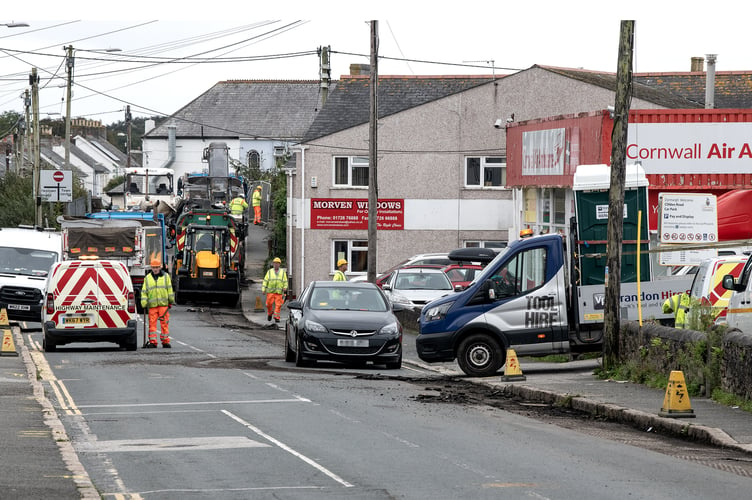
“It’s absolutely ridiculous that these giant surfacing machines are meandering around this car and makes a mockery of the ‘official’ notices issued,” the resident continued.
“It seems a simple case of Cornwall Council not employing joined-up thinking. This should have been avoided as clearly the enforcement authorities were well aware of this bizarre situation.”
Jeremy Parsons, manager of the Cosy Style store in Clifden Road, described the situation as “a bit crazy”.
“I spoke to the workers, who told me they were not allowed to move the car in case they damage it.
“They contacted the police, but were told it was a highways issue,” he said.
“It has been there for days, and has been ticketed nearly every day. Apparently it’s taxed and MOT’d. It’s mad that we’re going to have nice new tarmac with a square of old tarmac in the middle.”
Resurfacing was due to be carried out between Monday and Friday this week as part of planned highways maintenance work, with the road closed 24 hours a day to give teams teams “a safe working zone” between the hours of 7:30am and 5pm.
A letter sent to residents said marshals would be on site to support those needing access to local homes and businesses, with through traffic following diversions.
“To prevent delays, and to enable us to maintain emergency access, please do not park on or obstruct the highway during working hours,” the letter continued.
Cllr Richard Williams-Pears, Cornwall councillor and St Austell town councillor for Mount Charles and Poltair, confirmed that national legislation demanded the owner of the car be contacted before the vehicle could be moved. “I’m sure the council is doing everything it can to track down the owner of the car,” he said.
“Unfortunately, it’s one of those instances where it’s difficult if you can’t find them or they won’t talk to you. You can’t just move a car that is taxed and legally parked – if it’s damaged, the owner could have grounds to sue.
“That said, it is infuriating to see resurfacing work held up by selfish parking. We struggle enough to get highways maintenance carried out.”
A Cormac spokesman said: “This is an issue we regularly face across Cornwall. Unfortunately, we currently do not have any authority to move a vehicle obstructing maintenance work. On occasion we can approach the police for assistance, but this is not always the case and of course puts strain on their resource.
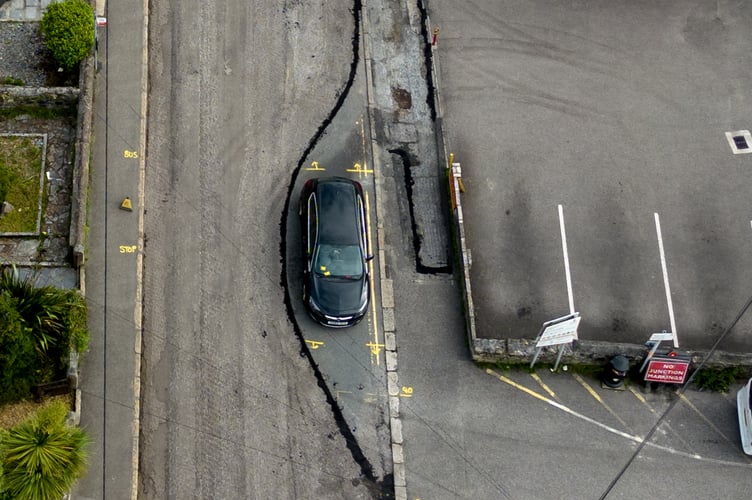
“Generally, we will resurface around the vehicle if it cannot be moved before works are completed on that section. The cost of returning to site for such a small area is quite significant, not to mention the impact of closing the road again.
“To do this we would need another legal order which can take up to three months to obtain and adds to the cost. The added obstacles on site can also prolong the surfacing operation and affect the quality of the finish.”
Comments
This article has no comments yet. Be the first to leave a comment.