
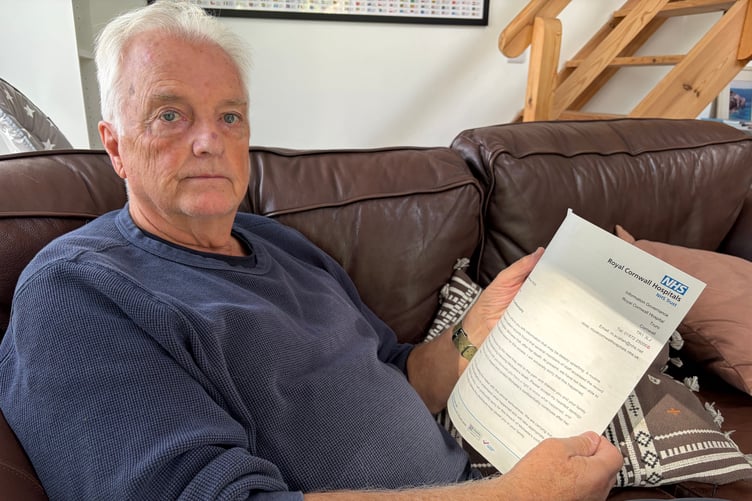
THE parents of a woman murdered by her abusive partner say their trauma has been compounded by the shocking revelation that hospital staff accessed her medical records after her death without permission.
Peter and Anne Hall spoke out after being notified by the Royal Cornwall Hospitals Trust (RCHT) that seven employees looked at their late daughter’s private files.
Michaela Hall, 49, from Mount Hawke, was killed in 2021 by her partner just two weeks after he was released from prison. He was later jailed for a minimum of 21 years. Her family have asked us not to name her murderer as they don’t want him to receive “the oxygen of publicity”.
The Halls, who live at Scorrier, showed me an email sent by the Trust which includes the positions of the people who accessed Michaela’s records, how many times and on what dates. Between 2022 and January this year her private details were read by a midwife, a trainee emergency admin worker, community hospital admin worker, medical records officer and a health office administrator.
A healthcare assistant accessed the medical records on seven different occasions, including twice on what would have been Michaela’s birthday. Peter and Anne are dumbfounded and can’t work out why staff would want to see her records.
Mark Scallan, RCHT’s head of information governance and data protection, wrote to the couple on September 1, saying he had information which they may find “deeply upsetting”, adding that a routine audit of access to patient records had unearthed the wrongdoing.
“I recognise that receiving the news may add to the pain and distress you and your family are already experiencing following Michaela’s death,” said Mr Scallan, who gave his “heartfelt apology”, adding that the Trust is carrying out an internal investigation. The Halls want the police to also investigate, but have been left disappointed by the response they have received.
Welcoming me into their home, where we sit beneath one of their favourite photographs of Michaela, the couple say they are speaking out now about the data breach as well as civil cases they are bringing against Devon and Cornwall Police and the Probation Service to help other victims’ families.
They are particularly eager to speak in light of the government’s early prisoner release scheme as they fear other domestic abuse victims, like their daughter, may also be killed.
Anne told me: “She’s not here to fight for herself. You can just curl up and say ‘I can’t get up today’ or you try and do something.”

Regarding the hospital data breach, she said: “Anything you want to know about the case, you can find online. You can even read the whole of the domestic homicide review, but this is something different. They’re going into her personal records – I’ve never seen her personal medical records; she probably wouldn’t want me to.
“The person who went in seven times is looking for something – and twice on her birthday. It’s very odd.”
Michaela’s son Shaun, 18, now lives with his grandparents. Peter said: “We had to tell Shaun what had happened. He must be thinking ‘why should anyone access my mum’s medical records when she’s dead?’
“You think, this is never-ending. From the family’s point of view, you can never put it to bed. Now we’re waiting for the NHS at Treliske to get their act together and let us know why this has happened.
“I didn’t have a lot of faith in the system before. Where are the checks and balances?”
Last week, NHS staff at another trust were removed from duty or suspended following a data breach involving the digital medical records of three-year-old Noah Woods, who was found dead after he went missing in the village of Brantham, Suffolk, earlier this month.
As a result, NHS England chief executive Sir Jim Mackey ordered every trust to take stronger measures against such data breaches. He said: “Anyone who thinks they can satisfy their curiosity by looking at a patient’s record should know this: they will be found out, they may lose their career and could end up with a criminal record.”
Responding to Sir Jim’s comment, Peter told me: “You can’t get a criminal record until someone tells the police, but we’ve been told categorically by Treliske that they’re not going to report it to the police. Apparently five of the people who accessed Michael’s records are not at Treliske any longer, though they could still be working for the NHS.
“We’ve been told by Treliske there was no criminal intent. How can they possibly say there is no criminal intent if they can’t see what they looked at and haven’t interviewed these other five people?”
The Halls have contacted the police about the hospital breach, but have received an email referring them back to RCHT’s data protection officer. “It’s gone full circle,” said Peter. “It’s absolutely stupid and not what we wanted to hear.”
Peter and Shaun appeared on BBC Breakfast last week to speak about Michaela’s murder in relation to the prisoner early release scheme. Her father says the killer was, in essence, released early.
“The probation office had to put a case to the judge so he could be released. A person within the Probation Service wasn’t qualified to write the report. She hadn’t read all of the information regarding the case. She made assumptions and put that in front of the judge.
“They rated him as ‘medium risk’. The Probation Service has subsequently agreed that he should have been ‘high risk’. Had that have happened, he would have stayed either in prison or in the Plymouth area. Because he was released as ‘medium risk’ he was referred to a probation organisation that no longer exists.
“When he was released they didn’t tell Michaela that he was coming ‘home’ – what he perceived as where he lived. He gave her address. He shouldn’t have given that address because they hadn’t asked her.
“He arrived at her house and two weeks later she’s dead. In the interim, the probation officer who should have been looking after him in the private sector organisation went on holiday for two weeks. The judge in his summary had said to the probation service, ‘I believe Michaela is at risk. If this person in any way breaks his conditions, I want him back in front of me immediately’.
“That couldn’t have possibly happened because the probation officer went on holiday for two weeks and didn’t return until the day Michaela died.
“So that was their failing. Then you have the situation with the police, who could have arrested him on a number of occasions because she was assaulted 16 times, but they didn’t.”
Peter said: “On the day I found her, they didn’t enter the property. Worse than that, the WPC leaving the property stated on her camera ‘she doesn’t help herself’. So there are a catalogue of issues.”
Commenting on the controversial early release scheme, he added: “The Probation Service is under so much pressure anyway, how could they possibly monitor this situation? I have some sympathy with people on the ground because they’re the ones who are going to end up in front of the coroner when someone gets killed.”
The Halls have two civil cases running against Devon and Cornwall Police and the Probation Service. “The police … because Michaela had a right to life and they didn’t preserve that by entering the property to find her. The Probation Service has partly already accepted responsibility because they accept he should have been ‘high risk’ not ‘medium risk’.
“They both should have responded to our case by June 3 and 4. They both wanted an extension for 28 days. The police did respond after 28 days. Four months later, we still haven’t got the report from the probation office. It should have been with us on Friday, September 25. We got an email on the Monday from our solicitor, saying they’ve asked for an extension until this Friday (October 2) and we still don’t have that report.
“That’s the same organisation that is looking after all of these prisoners being released. You wonder why people get frustrated and aggravated. I think we have a right to not accept this.”
Peter added: “People say, what do you want from all this? We want change. We want people to be held accountable, but no individual will ever be held accountable because, at the moment, you’re not dealing with individuals, you’re dealing with the legal departments.”
A proud grandfather, Peter says Shaun has turned into a great lad, who feels passionately about the early release scheme and the effect it could have on victims. Shaun told Naga Munchetty and Charlie Stayt on BBC Breakfast that he’s suffering from PTSD. “I’m surprised he said it,” Peter told me. “We know how his nightmares still exist and it doesn’t help when you have all of this going on.
“The people who have seen her medical records should be taken to task because they have no concept of how it affects people like Shaun. I’m a bit more thick-skinned, but it affects Anne hugely.”
Peter added: “Speaking about this takes a lot of out of you. It ain’t helping us! We could have easily buried our heads in the sand. It’s so that other people don’t end up in the same situation.”
RCHT’s chief people officer Alison Thorne-Henderson said: “Following a recent routine audit of our records system, we wrote to Mr and Mrs Hall to inform them that Michaela’s records had been accessed inappropriately and to apologise unreservedly. We are sincerely sorry this has happened.
“A full investigation is underway and our disciplinary process will be followed, with appropriate action taken.
“We are also reviewing our policy to ensure it is fully aligned with the new guidance from NHS England and have written to all staff to remind them of their responsibility to treat our patients’ information with the care and respect it deserves.
“We are absolutely clear that unauthorised access of records is unacceptable. For our staff this means it may lead to dismissal.”
Comments
We've recently changed our login process. If you have an account for commenting, you will need to re-register on the login window.
This article has no comments yet. Be the first to leave a comment.