
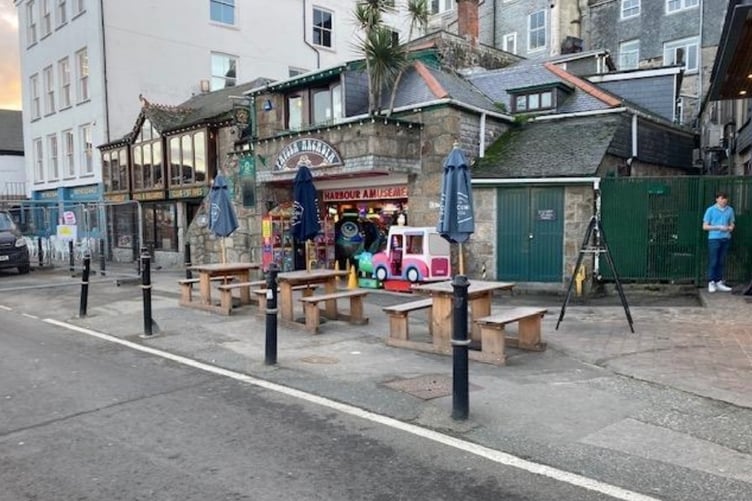
Neighbouring businesses complained to Cornwall Council over a bar and restaurant’s bid to keep bench tables on the pavement, saying they “cause chaos” and are blocking entrances and ruining trade. The objectors claimed the outdoor customer area results in “disgusting, dreadful litter and other filth” and “encourage seagulls and rats”.
However, David Fox, of the Balcony Bar And Kitchen on St Ives’ harbourfront, said the tables were an asset and contributed positively to the town centre by attracting visitors and stressed that the area was regularly cleaned by staff.
A Cornwall Council street trading and pavement licensing committee met on Monday (November 2) to decide if the restaurant could still place three four-seater benches on Wharf Road near the town’s long-standing amusement arcade.
Among neighbouring business’ concerns were that the presence of the tables was forcing queues for ice creams to block entrances. The applicant argued that the location of customer queues was not influenced by the presence of the benches. He expressed concern that the application process was being used as a means of totally removing the benches.
Five people spoke against the continued licence for three bench tables, which seat 12 customers, commenting that they cause access issues and were “impacting negatively” on their trade.
Reference was made to inconsiderate behaviour by some customers visiting the Balcony Bar and Kitchen, including prams being parked outside leading to restricted access to a gallery and inappropriate language used by customers on tables outside the arcade, which was frequented by families with children.
It was also mentioned that a table had been placed in front of a moveable bollard. Sometimes Balcony Bar and Kitchen customers had to get up and move from their table halfway through a meal so that a neighbouring business could gain access to load and unload.
Objectors also said safety was a concern as children running between tables could not be seen by passing cars. It was also noted that the gap between the road and the tables was 147cm, not the regulatory 2m, and forced people to walk into the road including wheelchair users and prams.
The businesses said they would prefer that there were no tables outside due to the negative impact they were having as discussed in the meeting and outlined in written submissions. They believed removing the tables would help to minimise antisocial behaviour.
In response to concerns regarding queue management, Mr Fox stated that removing the benches would not necessarily guarantee that queues would form in a different direction.

Referring to concerns about antisocial behaviour, the applicant acknowledged issues during major sporting events, including the World Cup, and stated that he had personally attended the premises to deal with incidents involving intoxicated people and inappropriate language. He added that managing younger people in the area on the road outside could be challenging.
Regarding cleanliness concerns, Mr Fox said that staff regularly sweep and clear the surrounding area and that additional staff had been employed during the summer months to manage the outdoor seating area.
He added that he wished to maintain positive relations with neighbouring businesses and galleries, noting that concerns had not been raised directly with him. The applicant indicated that he was approachable and willing to move benches if necessary and considered that vehicle access could still be achieved.
The restaurant owner told the meeting that the Balcony had previously reduced the number from five benches to three and considered that provided sufficient space on either side of the seating area. He told the committee a reduction of one table would be accepted.
Following a period of deliberation, members agreed to renew a licence for two not three benches. Councillors considered this way was a proportionate compromise to the situation as, in particular, the removable bollard will be freed up to allow for vehicular access at all times.
The committee reminded all parties that if issues did arise in future then the issues should be raised informally with the applicant in the first instance and with the relevant department of the council if appropriate.
Comments
We've recently changed our login process. If you have an account for commenting, you will need to re-register on the login window.
This article has no comments yet. Be the first to leave a comment.