
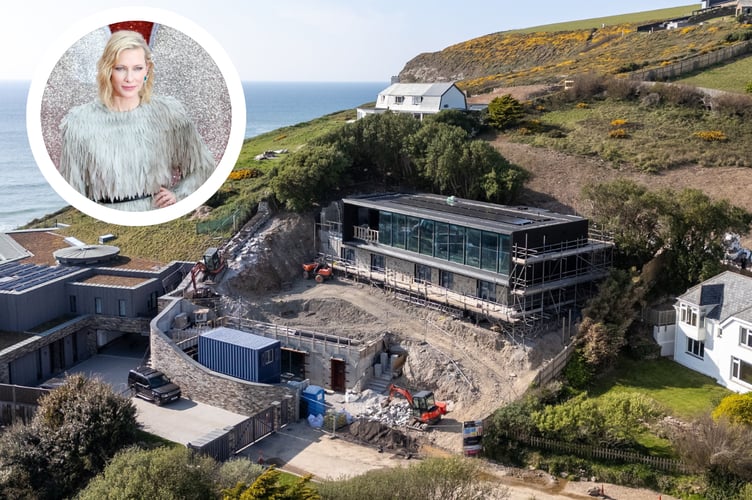
ACTRESS Cate Blanchett is facing opposition on plans to create a stunning garden at her Cornish home - as experts say her proposed lights could harm bats.
Oscar winner Cate, 56, has put in grand proposals for the land around her cliff top property in Mawgan Porth, Newquay, that includes local plants, trees, boulders - and a grass drive.
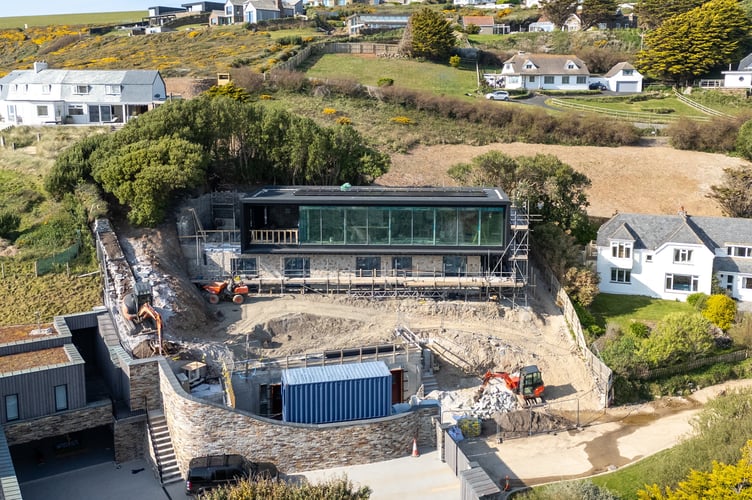
The star was given approval back in 2022 to knock down a £1.6-million cottage she bought with playwright husband Andrew Upton and replace it with a five-bedroom eco-home in 'Hollywood on Sea'.
The couple have now applied to discharge a number of conditions attached to the awarding of planning permission - including over lighting, landscaping and shutters.



In the latest application, four different types of lighting feature on the design plan, including eight pole mount path lights, three spike lights under trees, three low level step lights and four wall lights.
She built the five-bed eco-home after she got planning permission to knock down the £1.6m cottage she bought with her playwright husband Andrew Upton.
But an ecologist, who was formally consulted on the plans, has now written to state three of the four lighting options do "not comply with the guidance note referenced in the condition wording."
The condition wording of the original application given permission in 2022 stated: "Prior to the use of the dwelling hereby approved, a lighting plan as set out in the submitted ecological report to comply with Bat Conservation trust Guidance Note shall be submitted to and approved by the Local Planning Authority."
The previous report recommended outside lighting was "minimised where possible."
It added: "Where lighting is required for safety or security reasons, it is recommended these are low level, capped to direct light downwards and placed on short timers.
"Metal halide, fluorescent sources must not be used. LED luminaires to be used where possible due to their sharp cut-off, lower intensity, good colour rendition and dimming capability.
"A warm white spectrum will be adopted to reduce blue light component. These would conform with Bat Conservation Trust recommendations for lighting."
The preliminary appraisal of the building in November 2020 had assessed the building to have some suitability for crevice roosting bats.
A further survey carried out in May 2021, in the main active season for bats, did not reveal any bat emergence from the building or any evidence of bats within the attic space. There were also deemed to be "no active bat roosts" in the building that would be impacted by demolition.
But the report added: "As bats were found to forage across the whole area, recommendations are made for a low lighting regime as well as proposals for ecological enhancement of the development."
The latest plans were submitted to Cornwall Council by the couple on January 20.
They also include the 'mass planting' of olearia bushes, sea thrift, ornamental grasses like Ampelodesmos mauritanicus, and the 'scattering of Cornish boulders'.
The rest of the proposals includes installing hardwood decking next to the house, a grass driveway with concrete stabilisation from Greenstones pavers, as well as corten and cornish granite steps leading up to the large property.
The pair hope to have trailing Muehlenbeckia, a deciduous shrub which can be grown as a climber or ground cover, to create 'an evergreen curtain draping along the bank', and place ornamental trees (Phillyrea latifolia) next to the vehicle access site.
They have also proposed a boundary hedge of new Olearia Traversii, climbers to grow over balustrading (Lonicera alseuosmoides) and Oliaria Traversii to plant along their front room roof.
Comments
We've recently changed our login process. If you have an account for commenting, you will need to re-register on the login window.
This article has no comments yet. Be the first to leave a comment.