
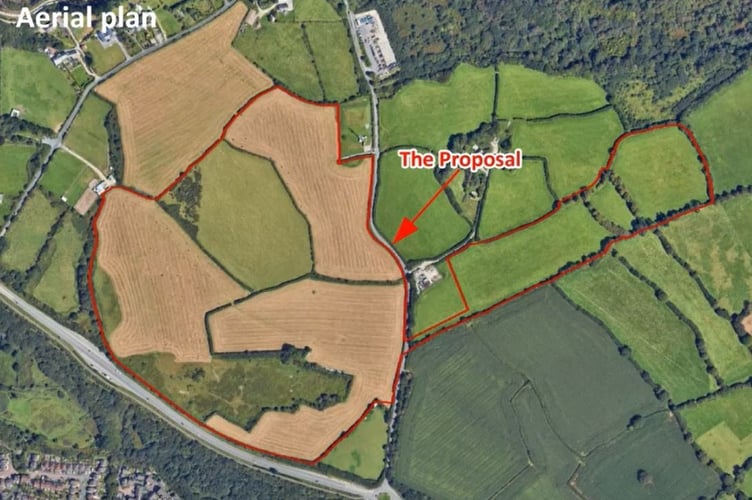
A solar farm which was refused by Cornwall councillors last year, fearing it would harm the landscape in St Austell, has been approved on appeal.
A Cornwall Council strategic planning committee heard last April that the solar farm on 25.5 hectares of land would “destroy” the last green fields in the landscape near the Cornish town.
Anesco Ltd, a UK based energy infrastructure company, applied to build the solar farm with battery storage on land at Menear Farm, between St Austell and Treverbyn parish. It would operate for 40 years and generate enough electricity to power 3,880 homes.
The company appealed the committee’s unanimous decision to refuse the application. A Government planning inspector has now sided with Anesco Ltd and approved the solar farm following a hearing on January 6.

An application for costs made by Anesco Ltd against Cornwall Council was refused.
Planning inspector Shaun Harrington, while noting there would be some harm to the landscape, said “the proposal would not cause ‘significant’ adverse impacts on the local environment”.
He also stated in his February 13 decision report that due to “the nationwide critical need for renewable energy facilities to come forward, [the] benefits are substantial and attract significant weight in favour of the proposal”.
Cllr James Mustoe, a Conservative councillor whose division contains St Austell Bay, said: “I’m really sorry to see the Bristol-based Planning Inspector decide, on behalf of the Secretary of State, to overturn Cornwall Council’s decision to refuse an industrial scale solar farm on green field land in Carlyon parish.”
When the application was submitted, Cornwall Council’s planning department agreed it would result in the loss of 11.2 hectares of best quality Grade 3a agricultural land, but pushed for approval as the public benefits associated with the renewable energy scheme were “substantial and outweigh the level of harm identified to the landscape, a non-designated heritage asset and agricultural land”.
However, councillors from across the area disagreed and called for the proposal to be refused.
Gary Hooper, of Treverbyn Parish Council, said at last April’s meeting: “There are multiple existing and proposed renewable energy developments in the wider St Austell area, and this development contributes to the increased industrialisation of the rural landscape, which has not been adequately assessed.”
He added that local residents were concerned about the impact the solar farm would have on their enjoyment of the countryside, increased flooding, the visual intrusion from panels and fencing, and the solar farm’s visibility from St Austell Bay, including Carlyon Bay and parts of the heritage site of Charlestown.
Matt Luke, who was then the Cornwall councillor for the area and had called the application to committee, said he had a number of objections but stressed it wasn’t “Nimby-ism” as there were numerous other sites within the parish, including solar farms, wind turbines and a geothermal development at the Eden Project, none of which had been turned down by the parish council.
“But this is the wrong thing on the wrong site for numerous reasons,” he said. “The visual impact is far wider than any of you can imagine. This land can be seen from the whole of St Austell Bay.
“These are the last green fields in the landscape – the rest has been built on. It will be visible in the landscape. To say it won’t is absolute nonsense. We will lose the last green buffer between St Austell and Treverbyn parish.”
Tom Clements, project lead for Anesco, told the committee that in policy terms there were no significant landscape effects and the site was naturally well screened. There would be the addition of native trees, hedgerows and other planting.
He said the company had noted local concerns about loss of agricultural land and had avoided high quality areas, and had demonstrated there were no lower grade sites available. The land has been used for sheep grazing for over a decade and that would continue.
Mr Clements added that drainage would address local flooding concerns and there had been plenty of public consultation.
He was asked a couple of times where the panels would be produced. “The majority of panels are produced in Asia and that is unfortunately the nature of the industry.”
Mr Clements stressed that a viable grid connection was vital for the project and there is a connection on site, which is “quite rare”. A lack of connection had counted out other brownfield sites, which would prove too costly.
Comments
We've recently changed our login process. If you have an account for commenting, you will need to re-register on the login window.
This article has no comments yet. Be the first to leave a comment.