
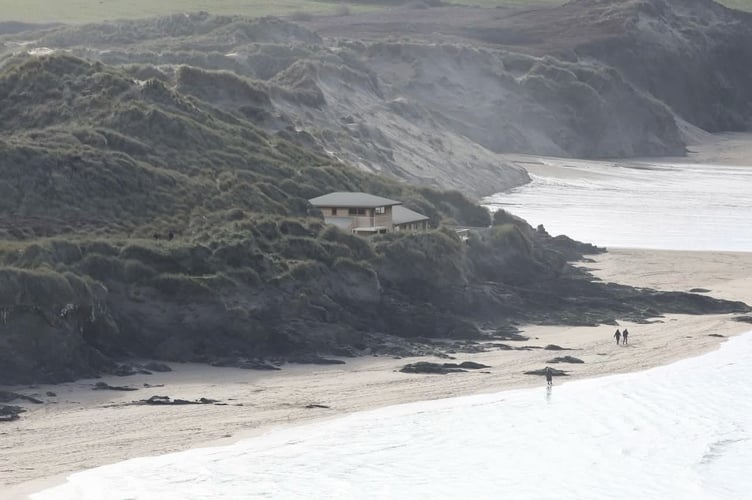
PLANS to build a new lifeguard station and surf lifesaving clubhouse at Crantock Beach need a wave of support.
A planning application has been submitted to replace the facility at Crantock Surf Lifesaving Club with a new off grid prefabricated building.
The surf lifesaving club states a more “resilient, future-fit space” is essential due to coastal conditions and shifting dunes.
The proposed design stays within the existing footprint to protect the dune habitat, which aims to improve visibility across the beach for safety and rescues and minimise impact on the landscape while adapting to the changing coastline.


A small second-storey addition will help maintain “clear sightlines” across the beach, especially towards the Gannel Estuary.
The planning statement said: “The existing building was constructed in the 1980s as a basic timber hut, and has been extended and adapted at various stages to serve the growing community and provide lifeguard cover to Crantock Beach.
“The Crantock SLSC have a potential funding opportunity to replace the hut with a more up to date building, which will enhance safety cover on Crantock Beach and provide improved facilities to the surf lifesaving club which continues to grow as the village of Crantock expands.
“Partial funding for the new building has been agreed via the DEFRA backed Making Space for Sand project.
“The project leaders initially suggested a modular design for the new lifeguard station, which would potentially allow the building to be re-located in the future within the evolving dune system. A modular design has been investigated and has been found impractical due to restricted access for cranes to bring modules to the site. A lightweight steel frame with prefabricated panels has therefore been agreed. This will achieve the same goal of making the building capable of relocation if necessary in the future. This approach will provide resilience within the evolving dunescape.
“The existing building is a timber lifeguard hut at the coastal edge of the Rushy Green sand dune system. When the hut was first constructed in this location, it was possible to access the site with vehicles via the gently sloping dunes.
“The topography of the beach has changed dramatically over the past two decades, leaving the hut perched above a rocky outcrop.
“The Gannel Estuary has widened out and meandered across the beach, creating a dangerous blind spot to the north east of the hut, which cannot be viewed from the single storey structure or surrounding terrace.
“The purpose of this application is therefore to seek permission to replace the existing hut with a more resilient and sustainable structure. The designs have been carefully considered and the proposals are developed using the existing building footprint to avoid impacting the sand dune habitat.
“Beach safety has also been a key factor in design development, and the building has been designed with the primary focus of providing surveillance cover to the entire beach, whilst reducing impact on the surrounding landscape and habitat. A modest second storey area has been an essential addition to maintain beach safety cover over the evolving coastal topography.”
Comments
This article has no comments yet. Be the first to leave a comment.