
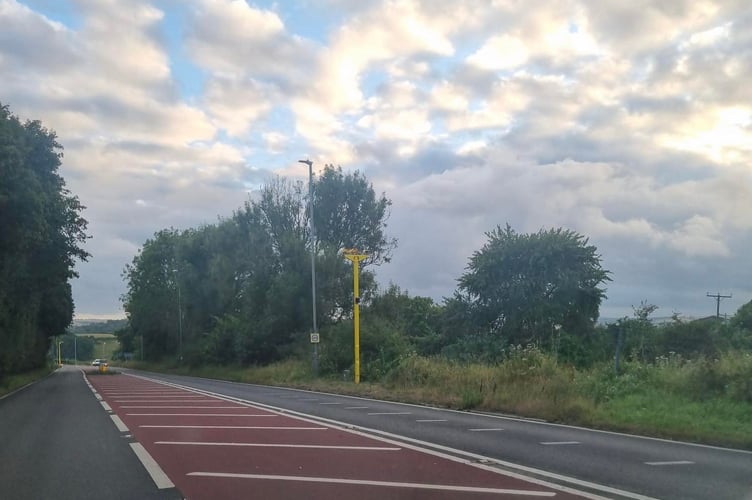
A STRETCH of the A38 in South East Cornwall has become a stark symbol of the region’s growing speeding problem, with Landrake now home to the busiest speed camera in the county.
Newly released figures show that 9,604 drivers were caught exceeding the limit travelling westbound through Landrake in 2025 alone. The highest recorded speed reached a staggering 85mph in what is clearly marked as a 30mph zone – a statistic that has alarmed both police and campaigners.
The Landrake data forms part of a wider surge in speeding offences across Devon and Cornwall. More than 237,000 motorists were reported last year, a dramatic rise from 78,624 in 2020. The number of Notices of Intended Prosecution (NIPs) issued by Devon and Cornwall Police has effectively trebled in just five years, reflecting both increased enforcement and what authorities describe as persistent driver behaviour.
Despite Landrake’s troubling figures, the single most prolific camera across the force area is located on the A383 Ashburton Road in Newton Abbot, Devon, where 10,134 motorists were caught last year.




Adrian Leisk, head of road safety at Devon and Cornwall Police, was blunt in his assessment: “If you don't want to get caught, don't speed.”
He pointed to the exceptional circumstances of 2020, when pandemic restrictions led to significantly reduced traffic volumes, but stressed that the upward trend cannot be ignored.
“Doing more of the same wasn’t an option,” he said, outlining a strategy that includes increased camera installations and expanded mobile enforcement teams under the Vision Zero South West partnership.
The initiative aims to cut road deaths by 50 per cent, focusing on high-risk areas where serious collisions are most common. According to Mr Leisk, enforcement is not about punishment but prevention.
“Where we place speed cameras, we see the numbers of people detected speeding drop off sharply,” he said. “Consequently, the number of people killed or seriously injured on that stretch of road drops dramatically.”
Drivers caught speeding face a choice – challenge the notice in court, accept penalty points and a fine, or attend a speed awareness course. But for campaigners, the issue goes beyond enforcement.
James Millidge, chair of the Safe38 campaign group, said the figures from Landrake highlight how easily drivers lose concentration.
“The high number of motorists caught speeding, especially at Landrake, shows just how many drivers suffer lapses of attention,” he said.
He pointed to the success of average speed cameras in the Glynn Valley, where serious and fatal collisions have fallen by 45 per cent in the five years since installation.
“This has both saved lives and boosted the economy due to fewer unplanned road closures,” added Mr Millidge, who believes similar results can be achieved along other sections of the A38, including between Trerulefoot and Carkeel.
“It’s far better drivers get a nudge to concentrate more carefully when driving on the A38 through a speed awareness course or three points on their license rather than a lapse of concentration resulting in a collision which, on this road, very often result in serious and tragic consequences.”
Comments
This article has no comments yet. Be the first to leave a comment.