
I RECENTLY wrote about my personal experience of Storm Goretti which included a two-day power cut. I think we had it comparatively easy in the Big Smoke - as Cornwall’s only city, a major population hub and the administrative seat and business centre of the Duchy, I’m guessing Truro was some way up the priority list for reconnection.
In contrast, some of Cornwall’s most rural pockets, its most vulnerable residents, were left without power, water or both for days on end. Elsewhere in this newspaper, you’ll find examples of people who were trapped in remote hamlets by fallen trees and power lines, or isolated at home due to their digital landline being disabled by the storm.
I wrote that piece with my impartial journalist’s hat on, but inside I was boiling with rage at the way older people, in particular, have been disenfranchised by the inexorable race towards online living. It’s hardly a new topic, but it has been pushed to the fore by Storm Goretti.
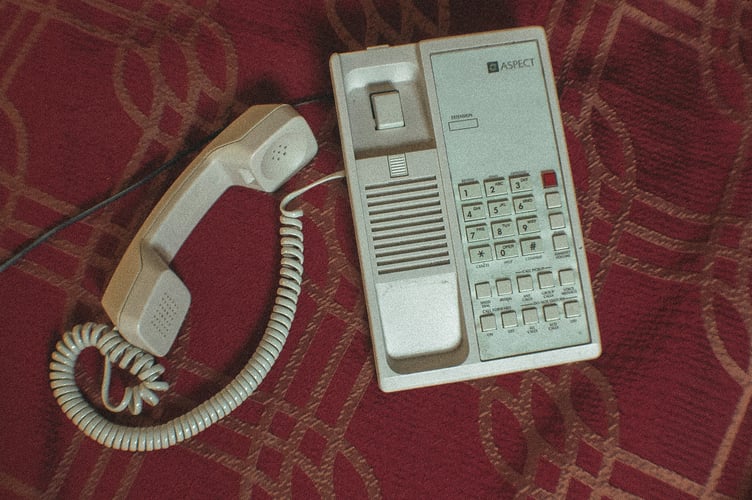
My friend Elizabeth lives in Perranarworthal with her mum and dad, aged 79 and 87, who found their BT digital landline – and lifeline - cut off by storm damage.

.jpeg?width=209&height=140&crop=209:145,smart&quality=75)
Elizabeth’s tale will ring bells with anyone who has ageing relatives: a struggle to engage with 21st-century technologies like smartphones or the internet; a preference to pay bills by cheque rather than direct debit; a fear of answering cold calls in case they are scammers, combined with a tendency to see the best in those same people and a baked-in reluctance to be rude to them.
As a result, Elizabeth manages many other aspects of her parents’ life, including their BT account. “The modern world is a confusing and scary place for them,” she says.
It’s a sign of how modern living has changed so drastically that older generations don’t stand a chance of keeping up. My own mother has lived in her house for four decades and has had the same telephone number for 50 years – a trivial thing for some, but deeply important to others. She has also had the same GP for some time, and likes the personal touch of seeing him at the surgery.
But a few months ago, Mum was referred to an external care provider for her arthritis. She was not keen on the idea of calling a company HQ 150 miles away to discuss her issues with a total stranger, and so found out belatedly that when she came onto their books, they sent her appointment details by text.
At no point did anyone think it would be sensible to check a 75-year-old was happy or even able to receive such vital information in this way. Nor did they show any empathy upon telling someone with mobility issues and no transport that her rearranged appointment would not be at her local health park, but at an unfamiliar location in a nearby town.
Mum was steaming, and I can understand why. I’m no digital native, but I am well-versed in speaking to any old GP over the phone and ordering repeat prescriptions via the NHS app. But I’m not in my late 70s with a list of serious ailments – I can imagine a familiar face might be reassuring in that scenario.
Meanwhile, like Elizabeth’s dad, my 91-year-old father-in-law (FIL) likes to pay big bills by check rather than bank transfer. A recent attempt to pay a stonemason resulted in a call from the bank’s fraud team to check he hadn’t been doorstepped by a rogue trader.
FIL is profoundly deaf, and doesn’t trust calls from the bank: “They might be scammers.” Fair point, but his cheque was cancelled, and the only way to authorise the payment was for me to spend half an hour on the phone to the bank, explaining how we’d found the tradesman through reputable means, and he’d carried out the work on our garden wall to our satisfaction, etc.
I know it’s not the bank’s fault there are unscrupulous people out there, and they are doing their best to stop them from defrauding a nonagenarian, but their methods don’t quite match up with their intentions.
It all smacks of lack of consideration. I return to Elizabeth’s parents, whose chunky big-button phone was replaced by BT with something resembling an old Nokia, all small buttons and tiny screen – utterly unsuitable for arthritic fingers and failing eyesight.
An architect neighbour explained the philosophy of modal shift: the urban planning strategy of a transition from, say, private cars to public transport to reduce congestion and lower emissions. Ideally this happens over generations, as each successive group is more at ease with new ways than the last.
We’d do well to employ this ethos elsewhere in life. Give the boomers a break – they’ll be gone soon, and they might actually have a few things to teach us before they leave.
Comments
This article has no comments yet. Be the first to leave a comment.