
I vividly recall watching, as a kid in the 1970s, the slew of graphic “Don’t drink and drive” adverts devised by the Department of Transport to educate viewers about the dangers of driving under the influence. I’d assumed folk of my generation and younger had absorbed this message, so I was shocked to learn, decades later, that some still think ‘one for the road’ won’t hurt.
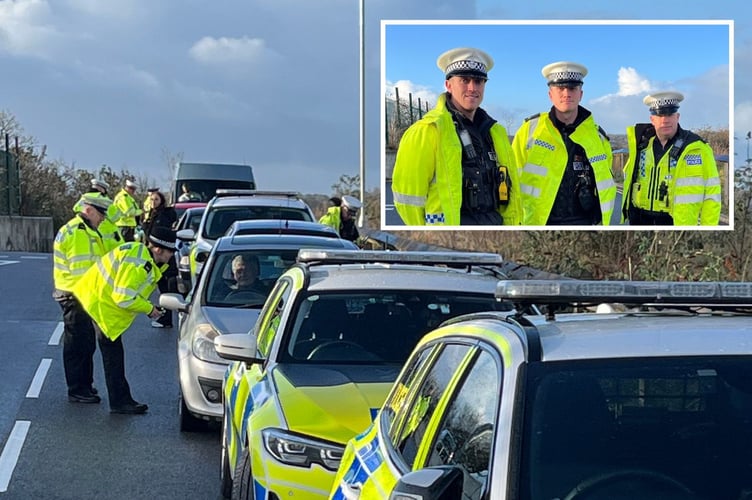
At 8.30am on a Friday just before Christmas, in a side road off the A390 next to the Truro branch of Lidl, I joined Devon and Cornwall Police traffic officers for Operation Limit – its campaign to remind drivers not to drink and drive.
Uniformed traffic officers waved people into the static site for breathalyser tests, saliva swipes (for drugs) and vehicle/document checks. While some were chosen at random, Moving Traffic Offences – poor driving style, a light out, a misted windscreen – were guaranteed pull-ins.
Why the early-morning swoop? Because alcohol remains in the system much longer than party-goers might imagine. “The body starts processing alcohol half an hour after your last drink, at a rate of one unit per hour,” said PC Dave Langley, road casualty reduction officer for Cornwall. “It takes five pints 15 hours to clear your system – and we don’t advise people to drive with any alcohol in their system.”


While coffee and a shower might make you feel better after a big night out, they won’t make you road-legal. Get caught, and the consequences range from losing your licence to a driving ban or a maximum penalty of six months in prison.
The worst-case scenario, of course, is that you hurt or kill yourself, or someone else. Dave recalls a single-vehicle incident when a morning-after driver ploughed his car into a tree and shattered his pelvis, an injury that would have a serious impact on his ability to work as a builder.
Drink-driving remains one of the ‘Fatal Five’ main causes of injury and death on the region’s roads (the others are excess or inappropriate speed, not wearing a seatbelt, driving while using a mobile phone and careless/inconsiderate driving). Drug-driving is on the increase, especially in the 18 to 25 age group.
Summer also sees an uplift in drink-driving stats: think longer nights, the beer garden or barbecue beckoning. As well as proactive pull-ins, the force sends officers out in marked and unmarked vehicles to spot potential offenders, and utilises social media and posters in bars to encourage people to find a “lift legend”.
Back to the side road, and before the exercise had even started, a young man pulled in voluntarily – through the exit lane, and with a light out. Three officers wandered over for a “chat”; by the time they’d finished, his breathalyser was clear but his ears were ringing with advice.
PC Richie Wilson was first to divert drivers in. Truro is his beat, making this job particularly meaningful. “It’s important to me that people are safe on the roads, because I’ve seen the consequences of the opposite, both professionally and personally,” he said. “As police officers, we are the ones who have to deliver the terrible news to loved ones, so anything we can do to prevent lives being shattered is worthwhile.”
Cars streamed in and out, the majority of drivers chatting and smiling with officers. One driver told me: “I’ve no issue at all with it - it’s a good idea at this time of year.”
There was the occasional concern at being late for an appointment; PC Scott Barrott gently reminded a woman rushing for a padel match that one should always leave plenty of time to reach one’s destination. “If not, you’re more focused on arriving on time than you are on the road.”
PC Scott was one of three officers from Bodmin with experience on the No Excuses team, a dedicated outfit of 16 that targeted repeat offenders. With the help of ANPR and tip-offs, it was able to make 600 arrests and remove dangerous drivers from the roads. This morning won’t see the same impact, but: “It’s about getting the message out there, to more people, and we can take someone off the road if there is reason to do so.”
By the end of the morning, there had been 41 negative breath tests, one vehicle seized due to the driver not possessing a valid licence and, just as the officers were about to call it a day, an arrest for driving under the influence of drugs – in this case, cannabis.
As I left, Richie was showing a family round his vehicle, letting a little boy sit behind the wheel before posing for selfies. It’s all good PR for the force, while reminding those of driving age: either go easy on the booze, or book a designated driver not only for the night itself, but also for the next day.
Comments
We've recently changed our login process. If you have an account for commenting, you will need to re-register on the login window.
This article has no comments yet. Be the first to leave a comment.