
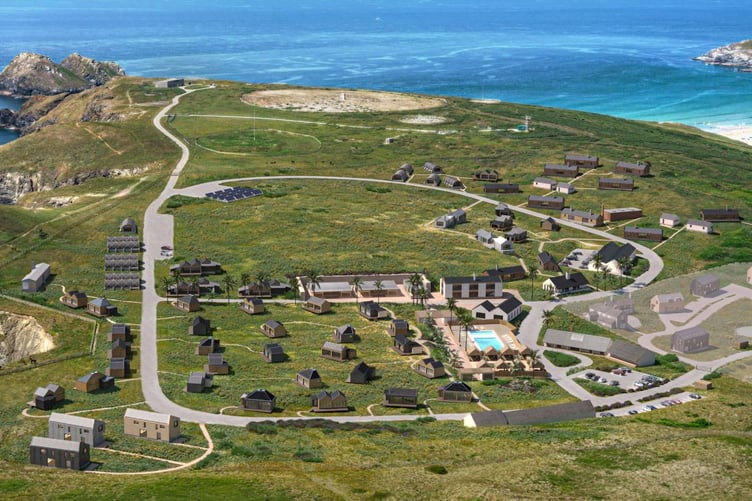
Just over a year ago a Cornwall Council planning committee refused a contentious application to build a holiday park on the site of a former Army camp near protected land, with one councillor dubbing it a “monstrosity”.
However, a government planning inspector has now overturned the decision and has approved an appeal by Clerkenwell Estates (Holywell Bay) Ltd to build a 67-unit holiday park with swimming pool, spa, shop, restaurant/bar, reception building and staff facilities on the former Penhale Camp near Holywell Bay.
The former Army camp at Kelsey Head, a headland separating Perran Sands at Perranporth from Holywell Bay, near Newquay, is home to fragile wildlife habitats, including Cornwall’s emblematic bird, the chough, an endangered species now feeding and breeding again at the site and showing signs of revival.
Kelsey Head and Penhale Dunes, which surround the application land, have been protected by a site of special scientific interest designation (SSSI) for several decades while Penhale Dunes has also been a designated special area of conservation (SAC) since 2004.



Residents in Perranzabuloe, Holywell and Cubert parishes set up a campaign to fight the holiday park plans five years ago.
In December 2024 Cornwall Council’s planning department recommended that plans for what would be a CABÜ Cabin Holiday Hideaway should be approved as the site is an effective use of previously developed land and an appropriate location for the scale of holiday development proposed.
However, after hearing the concerns of residents and two parish councils, the planning committee voted against officers’ recommendations and refused the holiday park proposal.
Following a two-day appeal hearing last November, planning inspector U P Han approved the development yesterday (Thursday, January 29).
The inspector said: “I conclude that the proposed development is of an appropriate scale to its location and would not have a harmful effect on the surrounding area including the area of great landscape value (AGLV).
“Following a review of the evidence and my own site observations, I concur with the overall conclusions of the LVIA (landscape and visual impact assessment), which indicate that the proposed development is unlikely to result in any significant landscape or visual impacts.
“This takes into account the primary/ embedded mitigation measures incorporated in the proposal to avoid, prevent, reduce and mitigate any likely adverse landscape and visual impacts.”
The Penhale Camp site includes 97 vacant buildings in varying states of deterioration, an internal road network and areas of hardstanding associated with its previous military use by the Ministry of Defence, which stopped in 2010.
The appeal report added: “The proposed replacement of deteriorated structures with better quality buildings and the choice of materials would make the new structures less prominent and better integrated into the surroundings.
“The replacement buildings would broadly replicate the scale and form of those they replace, while the new buildings have been sensitively designed with regard to their scale, form and materials.
“Local residents at the hearing described the former military camp as an historical and accepted feature of the landscape. While I acknowledge the long-standing presence of the former military camp, it remains visually discordant with its surroundings, particularly given its deteriorating condition and appearance which are likely to worsen over time.”
The inspector also concluded that the site is “reasonably accessible” by public transport, providing access to a range of services and facilities. As well as citing a harmful effect on the area, access was also an issue raised by the planning committee when refusing the original application.
Speaking at the November 2024 meeting, Edward Ledwidge, the applicant’s agent, said the CABÜ holiday park would be the fourth such venue (others are in Kent, Ireland and the Cotswolds), many of which are in sensitive environmental locations.
“The ethos of the development is to create high quality accommodation with wraparound facilities for non-exclusive use. The aim is to provide year-round accommodation that will be targeted at 11,000 short-term holidays which represents around 25,000 visitors.”
He said extensive work had been carried out with Natural England and the council’s ecologist to ensure protection of the sensitive areas during construction and operation. Mr Ledwidge added that it would be a £20-million construction programme, a considerable percentage of which would go to local businesses.
Comments
This article has no comments yet. Be the first to leave a comment.