
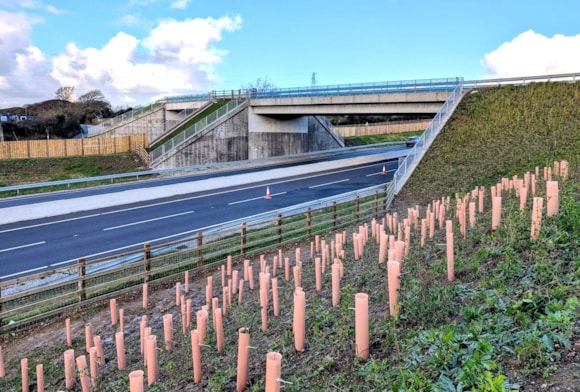
A PLANTING scheme is helping to put the finishing touches to the A30 dualling project.
A dual-deck bridge at Marazanvose constructed by contractors Costain over the new carriageway is now taking on its green appearance following tree planting as part of the major National Highways A30 Chiverton to Carland Cross upgrade.
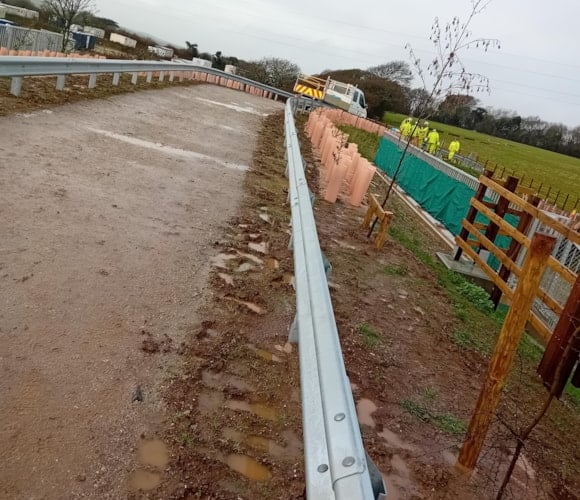
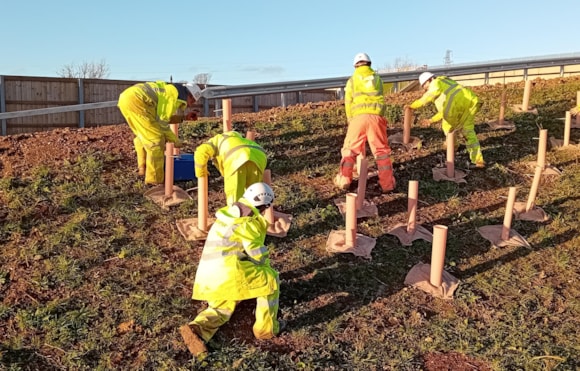
Landscaping has seen the planting of two native hedgerows, with species including hazel, hawthorn, holly, dog rose, elder and wych elm, along with hazel and hawthorn trees and seeding of grasses and wildflowers.
-from-above-(Picture-Paul-Richards).jpeg?width=209&height=140&crop=209:145,smart&quality=75)


Further seeding and planting will take part in the spring, and once completed, the green bridge will cater for a different type of traffic, providing a flourishing green crossing and a safe passage across the road for various wildlife species, including badgers, voles and other small animals, insects and birds.
The bridge, 49.3 metres in length and 12.5m wide, spans four lanes of the new dual carriageway and two lanes of the old A30, now the B3288, and will not only provide better connectivity for wildlife but also farm access and a bridleway for horse riders.
There are only a handful of green bridges across the country and for National Highways, it represents the third such structure to be built across the Strategic Road Network, and a second for Cornwall following the A391 Carluddon road bridge.
The company, responsible for England’s major A roads and motorways, has already constructed green bridges over the A556 near Chester and the A21 at Scotney Castle in Sussex, while further green bridges are under construction, as part of the A417 Missing Link scheme near Gloucester, and at Cockrow in Surrey, as part of the M25 Wisley interchange scheme.
Material for the top soiling work has been sustainably generated from the scheme’s earthworks, with around 960 tonnes of soil laid across the bridge deck and embankments, while a total of 87,000 trees are being planted across the landscape, in addition to the green bridge planting.
Andrew Alcorn, National Highways’ programme manager for the A30 Chiverton to Carland Cross scheme, said: “We’re really proud of the environmental work we’ve invested in this project, and the creation of the green bridge is a leading part of that.
“Along with other environmental measures, we’ve built a total of 33 multi-species crossing points as part of the project, and we look forward to seeing the bridge bloom for many years to come, providing a real legacy for the scheme and for Cornwall.”
National Highways and principal contractors Costain are predicting an approximate 20 per cent net gain in biodiversity as part of the environmental mitigation work.
Initiatives to protect and improve biodiversity alongside the new route include the creation of eight miles of traditional Cornish hedging, multi-species crossing points as well as the restoration of existing hedging.
The relocation of reptiles and a section of priority heathland habitat, the installation of over 28 miles of new drainage and the construction of a bat house, which is now home to a variety of roosting bat species, the creation of new wildlife-friendly filtration ponds and the construction of earth barriers and sound-absorbing and wildlife-proof fencing.
Tom Kenyon, project director at Costain, said: “We’re creating a more sustainable future by implementing nature-positive initiatives that enhance biodiversity. This includes designing and constructing green bridges which provide safe crossing points to join up habitats and make wildlife populations more resilient.
“The Marazanvose Bridge is one of many environmental benefits of the A30 dualling scheme, and in addition to deploying a circular economy approach for the topsoiling of the bridge, we’ve been able to forecast a biodiversity net gain of more than 20% across the scheme.”
National Highways as part of its designated funding stream, has also invested £1.02 million in Green Ribs projects to restore and recreate 16.8 hectares of woodland, orchard, grassland and heathland, and tree planting across the mid-Cornwall landscape, together with £11 million funding for Cornwall Council’s Saints Trails active travel initiative and £58,000 of Social Value funding to benefit local communities and charity groups, including Cornwall Blood Bikes, Cornwall Air Ambulance, Nansledan School, St Allen Parish Council and East Wheal Rose FC.
National Highways and principal contractors Costain have been progressing finishing works since opening the new dual carriageway to traffic in June 2024.
The scheme programme is now nearing completion, following local road connections opening at Trevalso and Pennycomequick, and the old A30 reopened between the Chybucca and Chiverton junctions in mid-December.
Lighting work has been finalised at the Church Lane underpass, which opened just before Christmas, CCTV technology has now been installed along the A30 section, and before the team leaves site, cabling work will take place from next month to enable lighting in the Newlyn Downs underpass, with landscaping work continuing into the spring.
After all planting and seeding work has been completed across the scheme’s landscape, a five-year maintenance period will follow to ensure the successful bedding in and growth of all new trees and shrubs.
The Trevalso and Pennycomequick underpasses are subject to daytime closures, for lighting and other minor works, and for all the latest updates on the scheme people can log on to the National Highways A30 Chiverton to Carland Cross web page.
The cost of developing the scheme has been funded by an £8 million contribution from the European Regional Development Fund, with an additional £12 million for the construction phase. The remainder of the cost of developing and delivering the scheme has been funded by central Government.
Comments
We've recently changed our login process. If you have an account for commenting, you will need to re-register on the login window.
This article has no comments yet. Be the first to leave a comment.