
It is easy to miss some of the wonderful wildlife on our doorsteps whilst we go about our hectic daily lives.
From orchids growing in the undergrowth to rare grey seals living along the coastline, which make up two thirds of the world’s population, there is an abundance of nature to experience and cherish.
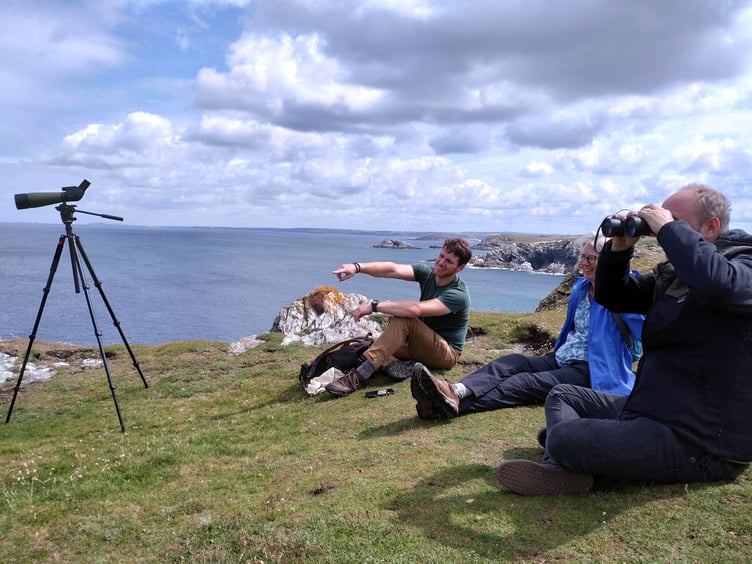
Nature lovers Laura Guy Wilkinson and Liz Clark from Newquay Marine Group have launched Newquay Wild Activities to help residents and holidaymakers reconnect to the amazing wildlife along the coastline and become citizen scientists by gathering data about the species they encounter.
They organise environmental activities such as wildlife walks and rockpool rambles led by local experts to paying customers to inspire and educate people to protect and conserve it. A percentage of profits are used to take out disadvantaged people for free of charge.


Laura and Liz offered me the opportunity to join one of their wildlife walks to help spread the word, which set off from Poly Joke.
Our expert on the day was Ivan Underwood, who recently graduated from Newquay University, and previously took up the challenge to live off food he had foraged.
He certainly was a man who knew what he was talking about regarding the wildlife, plants, geology and history we came across.
Certainly speaking for myself, who has a limited knowledge of the flora and fauna I spot whilst out in the countryside, having an expert on the walk was a great opportunity to get to know what we were looking at.
During the two-hour walk, which took in the countryside and the coastline, the group spotted 20 bird species, one snail, eight butterfly species, nine other insects including bees, one bumblebee mite species, 48 plant species and a group of grey seals.
Among the species of bird spotted were skylarks singing, chirping and enjoying a mud bath, stonechats, linnet, rock pipet, greenfinch and a willow warbler.
It was fantastic being told what the plants we were seeing, which included woody nightshade, a beautiful but deadly plant often found in hedges, sea radish, centaury, fat hen, buckthorn and pyramidal orchids.
Cinnabar caterpillars were busy feeding on ragwort. Birds have learnt not to feed on the caterpillars as they release cyanide, which would kill them.
Edible plants we came across included sea carrot, thyme and rock samphire, which is used in some of the top kitchens in the world.
Ivan said: “A lot of people do not realise that orchids grow in meadows and on cliffs. People think of the big purple orchids that can be bought in shops, but we have lots of incredible species here.”
Meadow brown butterflies were spotted along with the six spot burnet moth, which release hydrogen cyanide when threatened. Their colours serve as a warning.
There were numerous grey seals basking on rocks. Jet skiers did come close at one point but not close enough to disturb their sleep and digesting their food.
One of the grey seals had a tag after previously receiving rehabilitation and being released back into the wild. The sighting can be passed on to agencies, which helps monitor how the mammal is doing.
Each grey seal has its own distinct markings, which helps identify them when supplying data after encountering them.
The sand dunes at Holywell, Perranporth and Penhale is one of the biggest in Europe. It was Interesting to hear how sand dunes are formed.
Laura said: “We want to show Newquay in a green light.
“The aim is by showcasing the wildlife that share the coastline people will be inspired and educated to protect and conserve it.
“Come along and be inspired and educated to protect and conserve it while having a great day out.”
Comments
This article has no comments yet. Be the first to leave a comment.