
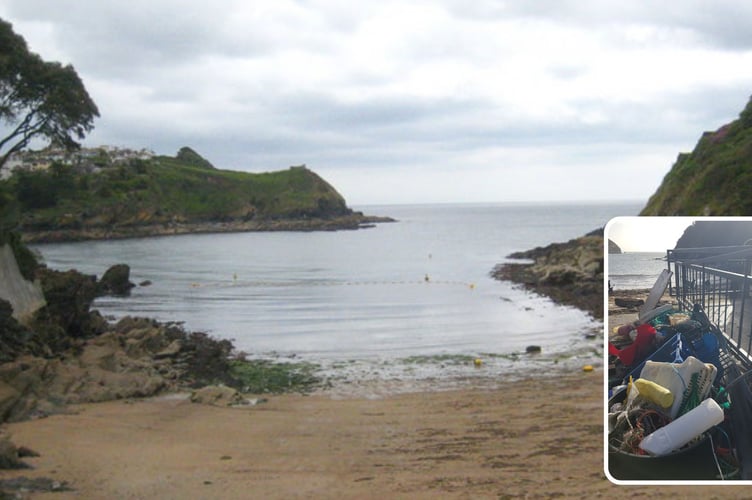
WHAT should be one of Cornwall’s most picturesque coastal spots has instead become a frontline in the growing battle against marine pollution.
Readymoney Beach near Fowey has been left littered with debris washed ashore by recent storms, leaving local businesses and residents asking who is responsible for clearing it up.
Piles of ghost fishing gear, plastics and other marine waste have built up along the sand, disrupting daily life at the popular beach. While volunteers have been quick to step in and collect what they can, the problem does not end once the rubbish is bagged. In many cases, it simply has nowhere to go.
Victoria Clark, who runs the Readymoney Beach shop, said: “It’s frustrating because it ends up falling to members of the local community to resolve, and that’s when it becomes difficult. The Fowey community has been brilliant at stepping up – people genuinely want to help. One local couple even offered space in a skip they were using for building work.



.jpg?width=209&height=140&crop=209:145,smart&quality=75)
“People do rally round, but it raises the bigger question: should this be down to the community, and where does the responsibility really lie?”
Once debris is removed from the beach and placed in piles, it is no longer classed as marine litter but as fly-tipping, creating further complications. Local resident Lindsay Raue said this had left people caught in a catch-22 situation.
“People are doing the right thing by picking it up, but there’s nowhere to put it,” she said. “Cornwall Council came recently, but said it was fly-tipping because it had been left on the road – even though that was the only way for it to be collected.”
The confusion appears to stem from a tangled web of ownership. Readymoney Beach itself is owned by the Harbour Commissioners, the slipway’s ownership is disputed, while the access road is the responsibility of Cornwall Council. Residents say this fragmented arrangement means no single authority is responsible for clearing storm debris on a large scale.
Another resident, Trisha Ade, warned the situation could damage Fowey’s reputation as a tourist destination. “People are really angry,” she said. “Visitors come down and see the beach like this, it’s going to put people off.”
Normally, beach users are expected to carry litter to nearby bins, but locals say that approach does not work when storms dump large volumes of waste in one go.
After seeing Victoria’s appeal on social media, community interest company Beach Guardian stepped in to remove the rubbish for responsible disposal.
Director Rob Stevenson, who stressed the problem goes far beyond one beach, said: “Cornwall Council has a good system in place when a beach is under its control. The problem arises when it isn’t. Much of this material has been in the sea for years and travelled from all over the world. It’s an ocean-wide problem, and Cornwall needs a clear solution for managing waste on beaches that aren’t council-owned.”
Until that happens, residents fear they will continue to rely on goodwill, volunteers and charities to keep their coastline clean.
Comments
This article has no comments yet. Be the first to leave a comment.