
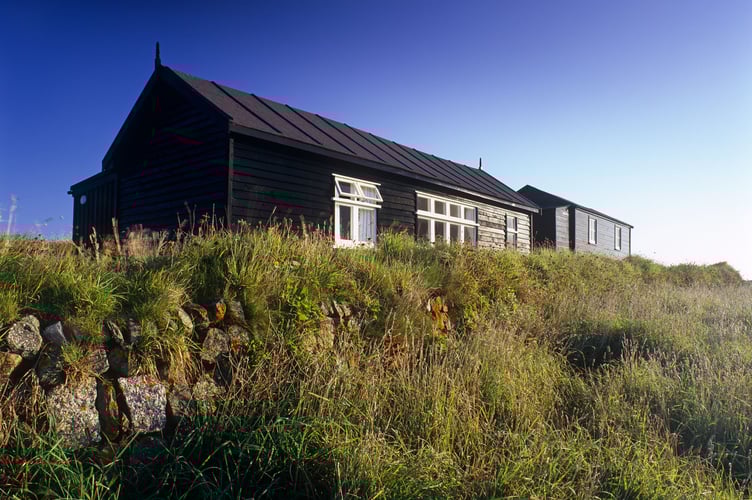
THE National Trust is celebrating the 125th anniversary of the Lizard Wireless Station, a remarkable clifftop site that played a pivotal role in the early history of wireless communication and helped change how the world connects.
Opened on the first of January 1901, the station became one of the first commercial wireless telegraphy stations in the world, communicating with ships up to 80 miles away and pushing the boundaries of what was thought possible at the time.
Later that same month, the station achieved a world record when it successfully received a wireless signal from St Catherine’s Point on the Isle of Wight - proving for the first time that radio waves could follow the curvature of the Earth.
This breakthrough paved the way for long-distance communication and laid crucial groundwork for Guglielmo Marconi’s famous transatlantic transmission from nearby Poldhu later that year.
-Mann-a-paramedic-for-over-20-years-has-been-awarded-the-Kings-Ambulance-Medal-(K.jpeg?width=209&height=140&crop=209:145,smart&quality=75)



Today, the Lizard Wireless Station remains a place where history is not only preserved but actively lived.
Cared for by the National Trust and supported by passionate volunteers, the site continues to operate as an amateur radio station, connecting modern radio enthusiasts with the very landscape and conditions that made these early experiments possible.
To mark the 125th anniversary, the station’s historic call sign will be active throughout January, and visitors will be welcomed inside, offering a rare glimpse into a site where global communication history was made.
After retiring in 2016, and following the departure of the previous volunteer who managed the role, Geoff Bate officially took on responsibility for the wireless station’s amateur radio operations in 2017.
“It’s hard to describe what makes this place so special," he said. "It’s the location, the history, and the people. I’ve always loved history, and here you can meet people, inspire them, and help them understand just how important this place is."
Geoff is always happy to give visitors a behind-the-scenes look, but his role primarily focuses on maintaining and managing all aspects of amateur radio activity at the site, including equipment upkeep and liaising with visiting radio amateurs who travel to the Lizard to operate from this historic location.
A lifelong interest in radio led Geoff to this role. After experimenting with citizens band radio when it became legal in the early 1980s, he went on to study City & Guilds qualifications and qualify as a radio amateur.
To access short-wave radio, he even learned Morse code - a skill still closely associated with the station’s history. Today, he describes himself as a “jack of all trades”, overseeing everything from equipment maintenance to managing access to the masts and aerials.
Perched dramatically on the clifftop, the station offers a unique blend of history and living heritage. Inside, one area has been carefully laid out to reflect how the equipment would have appeared in Marconi’s time, while adjoining spaces house a small museum of radio artefacts alongside a functioning amateur radio station.
Geoff said: “People don’t always realise just how important this site is. The Lizard Wireless Station played a key role in proving that wireless signals could travel over vast distances and even follow the curvature of the Earth — that was world-changing at the time. This was where wireless communication really began to prove itself. What happened here helped lay the foundations for the connected world we live in today.”
To mark the 125th anniversary, volunteer radio operators will be on air between 10am and 4pm on the following dates: January 1-3, 9-10, 12, 15-16, 19, 22-23 and 27-28.
Due to the exposed clifftop location, opening is dependent on safe conditions, but when the weather allows, visitors are warmly invited to step inside and learn more about the station’s extraordinary history.
Comments
This article has no comments yet. Be the first to leave a comment.